• Floor Coatings
What a Moisture Vapor Barrier Is and Why You Need One
TL;DR
- Concrete is not waterproof. A slab on grade sits on damp soil, and moisture moves up through it continuously as vapor.
- A coating is not breathable. Put a sealed film over a slab that is still giving off vapor and the vapor has nowhere to go, so it collects underneath and pushes.
- That is what blistering and delamination actually are. Not bad luck, and usually not bad product. Trapped vapor.
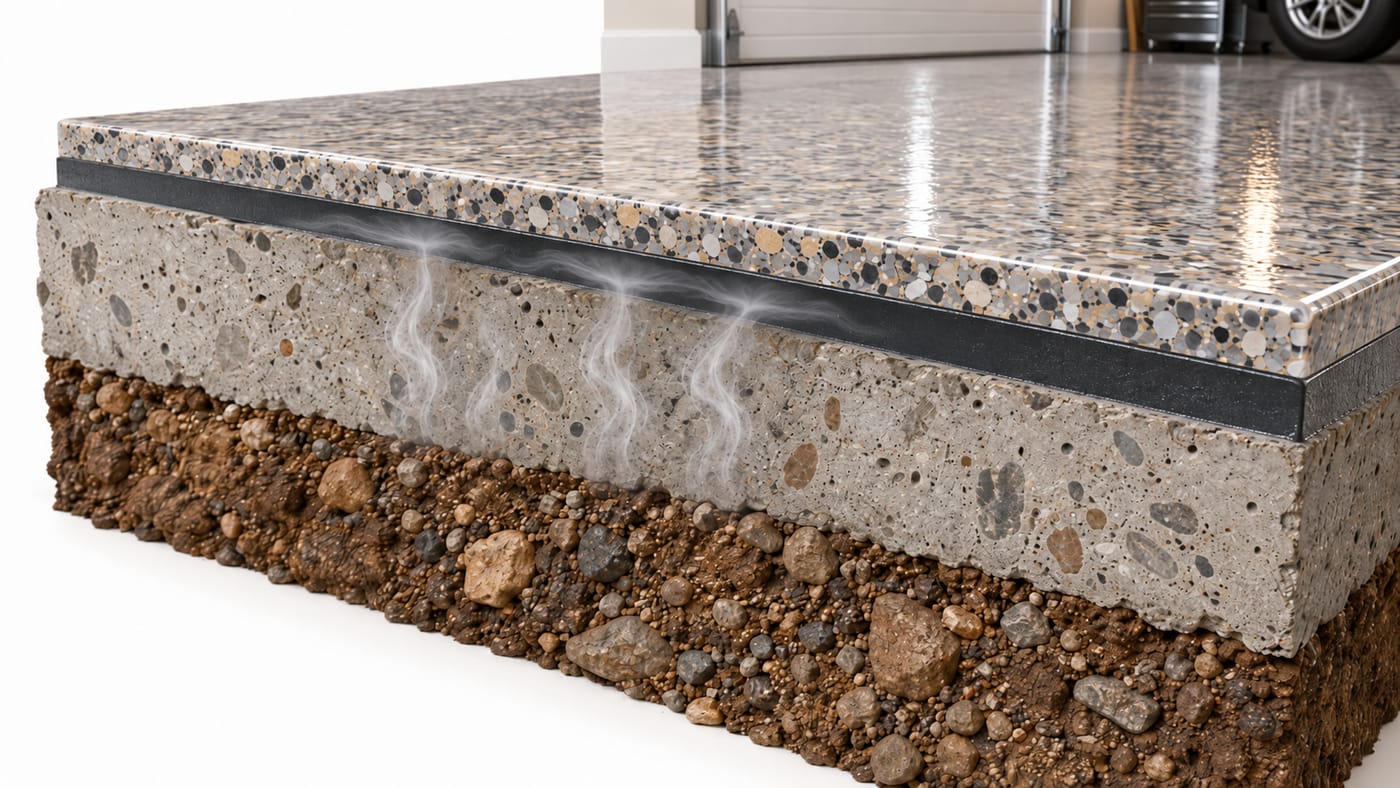
- A moisture vapor barrier is the base layer that handles it, a high solids epoxy applied directly to prepared concrete as the first coat, before any color.
- Dry Idaho air does not protect you. Vapor moves from higher pressure to lower, so dry air above a damp slab increases the drive rather than reducing it.
- It is testable, not a guess. Two standard tests exist, and the number on the test is what tells you what the slab needs.
Start with where the water is
Your garage slab is poured on dirt. Underneath it there is soil, and soil holds water.
Concrete looks solid but it is full of microscopic capillaries, which is why bare concrete stains when you spill something. Those same capillaries work in the other direction. Ground moisture wicks up into the slab and evaporates off the top surface as water vapor, continuously, for as long as the house stands.
In an uncoated garage you never notice, because the vapor reaches open air and leaves. The slab is breathing and nothing stops it.
That is the entire picture you need before anything else makes sense. The concrete is not dry. It is a path.
Why dry air makes it worse, not better
This is the part that surprises people here.
Water vapor moves from an area of higher vapor pressure to an area of lower vapor pressure. A damp slab has high vapor pressure inside it. The air above it, in a Magic Valley garage with around ten inches of annual precipitation, has low vapor pressure.
Bigger difference, stronger drive. Our dry air pulls vapor up through the slab harder than humid air would.
So "it is dry in Idaho" is true about the air and irrelevant to the slab. What matters is what is underneath the concrete, and that has nothing to do with how dry it feels when you walk outside.
What is underneath, around here, is often wetter than the climate suggests. This is irrigated country. Subdivisions sit on ground that was farmed under irrigation, lawns get watered all summer right up against the garage, and many older slabs were poured with no vapor retarder sheet underneath them at all. Garages in particular tend to get less care at the pour than conditioned living space does.
What happens when you coat over it
A properly built coating is a sealed, non-porous film. That is the point of it. It is what keeps road chloride off your concrete all winter.
But sealing the top of a slab that is still pushing vapor upward creates a problem. The vapor arrives at the underside of the coating and cannot pass through. It accumulates. It builds pressure.
Eventually the pressure exceeds the bond strength between the coating and the concrete, and the coating lifts. That is a blister. Once a blister ruptures, water gets into the opening and the separation spreads outward from there.
The scale matters: many standard coatings tolerate only a few PSI of pressure from underneath. Purpose-built moisture mitigation products are tested far higher, with urethane cement systems rated to around 20 PSI.
So when you see a garage floor with bubbles, flaking patches, or a section that lifted off in a sheet, the usual cause is not a cheap product or a bad batch. It is a coating applied over a slab that was never checked, and it looks exactly like a product failure to the homeowner paying for it.
How this gets measured
Moisture is not something an experienced eye can judge from looking at a floor, which is why the industry has two standard tests.
The calcium chloride test, ASTM F1869. A measured dish of crystals is sealed under a cover on the slab, left in place for 60 to 72 hours, and weighed again. The result is a moisture vapor emission rate, expressed in pounds of moisture per 1,000 square feet per 24 hours. Three pounds is the figure commonly used as a general limit, although the standard itself sets no pass or fail number. The real limit is whatever the coating manufacturer specifies.
The honest caveat on this test: it only measures the surface. Research has found it can produce both false highs and false lows, ambient conditions skew it, and the equipment cannot be calibrated.
The in-situ relative humidity test, ASTM F2170. A probe is placed in a hole drilled into the slab, at 40 percent of the slab's depth for a slab poured on grade. It reads relative humidity and temperature inside the concrete, and readings are valid 24 hours after insertion.
This one is generally considered more reliable, for three reasons. It measures conditions inside the slab rather than at the surface, which is what predicts performance after the floor is sealed. The equipment can be calibrated against traceable standards. And it is faster.
Either way, the point is that there is a number. A contractor who tells you the slab is fine without producing one is telling you an opinion.
What a moisture vapor barrier actually is
Here is the plain version.
It is the first coat that goes down, directly onto freshly prepared concrete, before any color or flake. It is typically a one hundred percent solids epoxy, meaning essentially nothing in it evaporates away during cure, so what you apply is what stays on the floor as thickness.
Two jobs at once. It penetrates into the open pores of the profiled concrete and bonds mechanically, and it forms a sealing layer that resists vapor pushing up from below.
That bond is why surface preparation decides so much. A barrier coat that is sitting on a smooth, unprofiled slab has nothing to grip, and the vapor underneath only has to beat a weak bond.
In our system the order is: diamond shot blast, moisture vapor barrier epoxy base, flake broadcast into it, UV stable polyaspartic clear on top. The full build is here. The base coat is the layer doing this specific job, and it is also the layer most commonly left out of a cheap quote, because it is invisible once the floor is finished.
Worth being clear on a limit: a standard barrier coat is not unlimited. A slab with genuinely severe moisture, a high water table or active hydrostatic pressure, needs a dedicated mitigation system rather than a standard base. That is a different specification and a different price, and it is one reason the testing happens before the quote rather than after.
Why this is the line between two quotes
If you are comparing prices, this is often where the difference is hiding.
A single-layer floor with no barrier base is faster to install and cheaper to sell. It also looks identical on day one. The difference shows up in year two or year three, as blisters, as a lifted patch near the door, or as a section that comes up with a tire.
It connects to the one-day install question directly. A full system can genuinely go down in a day. A system that fits in a day because the base coat was skipped is a different product wearing the same description.
Three questions worth asking any contractor, in this order:
- Did you test the slab for moisture, and what was the number?
- Is there a moisture vapor barrier base coat, and is it written on the quote?
- What happens if the test comes back high?
That third one is the useful one. A contractor who has a real answer, meaning a mitigation system and a revised price, has done this before. A contractor who says it will not be an issue has not tested it.
Get the number before you get the floor
A free in person estimate includes a proper look at your slab, moisture addressed before anything is promised, and the full system written on the quote so you can see what you are buying.
Get My Free Quote · (208) 731-1729
Twin Falls, ID. Serving the Magic Valley including Jerome, Kimberly, Burley and Mini-Cassia, Buhl, Filer, Wendell, Gooding and the Wood River Valley.
Frequently asked questions
What is a moisture vapor barrier on a garage floor? It is the first coat of the system, usually a one hundred percent solids epoxy applied directly to prepared concrete. It bonds into the slab and forms a sealing layer that resists water vapor moving up from the ground underneath, so that vapor cannot collect beneath the finished floor and lift it.
Does my garage really have a moisture problem in a dry climate like Idaho? Possibly, and the climate does not answer the question. Slab moisture comes from the soil beneath the concrete, not the air above it. Dry air actually increases the pressure difference that drives vapor upward. The only way to know is to test.
How do you test concrete for moisture? Two standard methods. The calcium chloride test, ASTM F1869, measures surface emission over 60 to 72 hours and reports pounds per 1,000 square feet per 24 hours. The in-situ relative humidity test, ASTM F2170, puts a probe inside the slab and reads at 24 hours. RH testing is generally considered more reliable because it measures inside the concrete and the equipment can be calibrated.
What does a failing floor look like? Blisters or bubbles in the surface, patches that have lifted away from the concrete, flaking along edges or the door line, and sections that come up when something is dragged or a warm tire sits on them.
Can a moisture problem be fixed after the floor is down? Not by patching over it. Once a coating has delaminated, the affected area has to come off and the underlying cause has to be addressed before anything goes back down. That is considerably more expensive than testing beforehand.
Is a moisture barrier always necessary? A properly built residential system includes one as standard, because it costs far less to include it than to find out it was needed. The separate question is whether a slab needs a full mitigation system beyond the standard base, and that depends on the test result.
Do tiles or mats avoid this problem? They avoid the blistering, because there is no bonded film to lift. They do not avoid the moisture. Vapor still arrives at the top of the slab and now sits under a covering, along with whatever came off your tires. More on that in our comparison of the options.