• Floor Coatings
Why One-Day Install Means Two Different Things
TL;DR
- One day describes the schedule, not the system. Two companies can both promise it and install completely different floors.
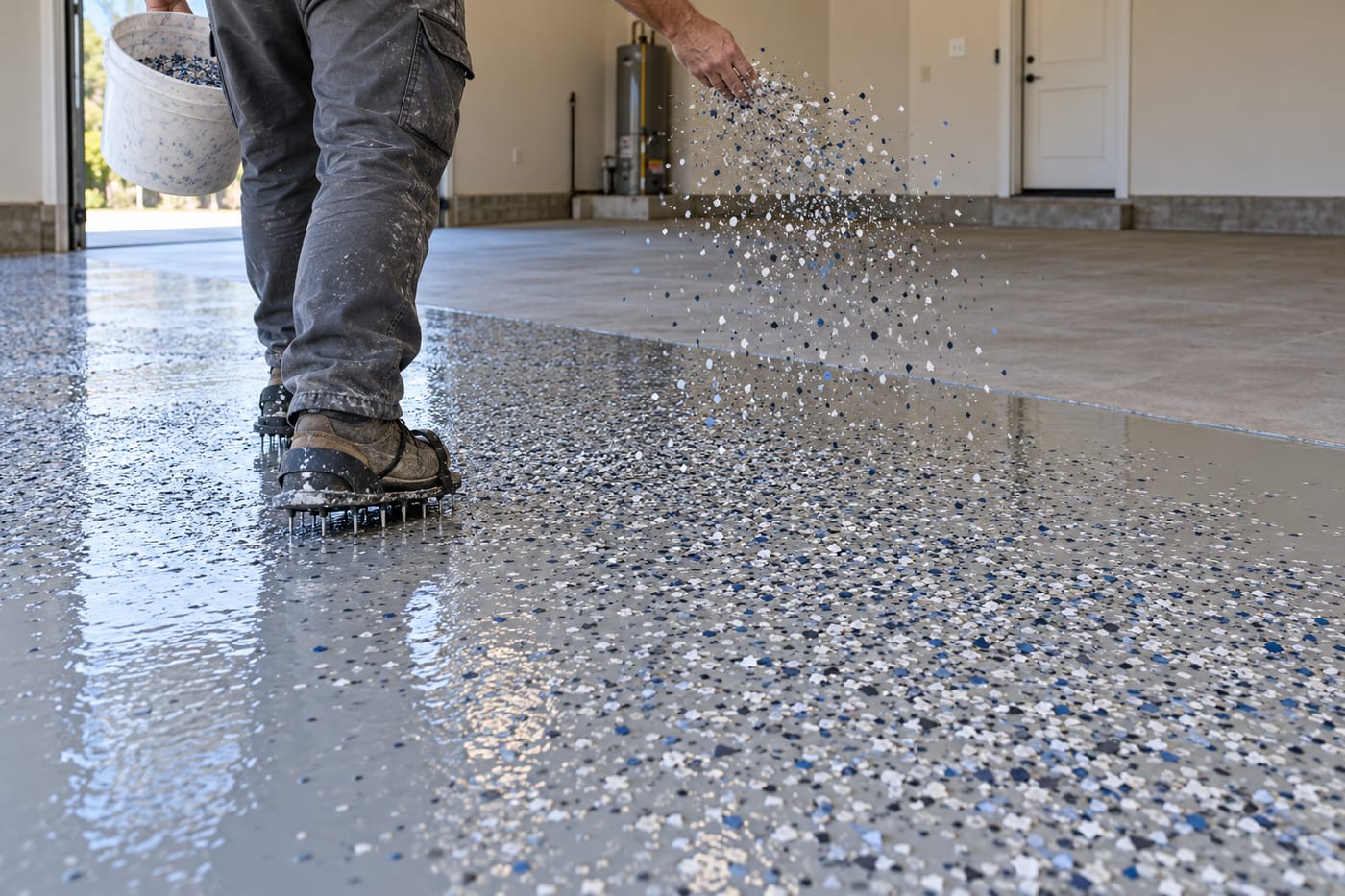
- Done properly it means the whole system goes down in a day: shot blast, moisture barrier epoxy base, flake broadcast, polyaspartic clear.
- Done as a shortcut it means there is less to install. Lighter prep, no sealing base, a thinner single-layer coat.
- Polyaspartic is what makes one day possible, because it cures in minutes rather than hours. That is a reason to use it as the top coat, not as the entire floor.
- Install day is not ready day. Expect foot traffic the same evening and vehicles considerably later.
- The question to ask is not how long. It is what goes down.
The claim everyone makes
Search for a garage floor coating in the Magic Valley and nearly every company will tell you the job takes one day. We say it too.
The problem is that the phrase has quietly come to mean two different things, and the gap between them is the difference between a floor that lasts and one that does not.
One version means the full system is installed in a single day because the chemistry allows it. The other means the job fits in a day because there is less of it.
Same three words. Very different floor.
What makes a one-day install possible
The honest technical answer is polyaspartic.
Traditional epoxy cures slowly. It takes roughly five to twenty times longer than polyaspartic to reach cure, which is why an all-epoxy system typically needs three to seven days before the garage is usable again, with waiting time built in between coats.
Polyaspartic cures in minutes per coat rather than hours. That is a genuine material advance, and it is what collapsed a multi-day job into a single day.
So one-day installs are not inherently a gimmick. The chemistry is real.
Where it goes wrong
Here is the part worth understanding.
Polyaspartic cures so fast that it often does not soak into prepared concrete as well as epoxy does. The slower material has time to penetrate and lock into the open pores of the slab. The faster one is setting while it is still sitting on the surface.
Which means a floor built entirely from polyaspartic trades away bond strength for speed.
The right answer is to use each material where it performs best. A moisture vapor barrier epoxy base goes down first, because it has the time to penetrate and seal the slab. Flake gets broadcast into it for thickness and grip. Then a UV stable polyaspartic clear goes on top as the wear layer, where its fast cure and chemical resistance are exactly what you want.
That system installs in a day. The speed comes from the top coat, not from skipping the bottom one. The full build is on our how it works page.
What a shortcut one-day job actually leaves out
When one day is the selling point rather than a consequence of the system, the time has to come from somewhere. Usually one of these.
Prep. Acid etching or a quick clean instead of diamond shot blasting. It is faster, and it is the single most common reason coatings fail, because the coating never gets a mechanical key into the concrete. We covered the difference between prep methods separately.
The sealing base. A polyaspartic-only floor has no moisture vapor barrier underneath it. In a Magic Valley garage, where moisture moves up through the slab and freeze cycling works on it all winter, that is the layer you least want to lose.
Mil thickness. A single thin coat goes down faster than a base, a full flake broadcast and a clear. It also wears through faster and is far more vulnerable to hot tire pickup.
Recoat timing. Polyaspartic has a short window between coats. Rushing a full day of work means that window is easy to miss, and layers that do not bond to each other properly can delaminate later.
Room for problems. Prepping a slab and applying several layers inside a working day leaves no slack for a damp patch, a bug in the finish or windblown grit. On a tight schedule, something gets accepted that should have been fixed.
The other thing people get wrong
Even when the install genuinely takes a day, that is not the same as the floor being ready.
One-day install means the crew arrives, does the work and leaves the same day. It does not mean you park on it that evening.
Expect light foot traffic the same day. Vehicles need considerably longer, typically somewhere in the 24 to 72 hour range depending on the product and the temperature. The coating is still chemically hardening after it feels dry to the touch.
Parking too early is a real failure mode rather than a technicality. A warm tire on a coating that has not fully cured is exactly the condition that lifts it, which is the mechanism behind hot tire damage.
Ask for the vehicle cure time specifically, not the walk-on time, and ask in writing. Those are two different numbers and companies are not always careful about which one they quote.
What to ask instead of how long
The useful questions are about the system, not the schedule.
- What prep method is included, and is it written on the quote?
- Is there a moisture vapor barrier base coat, or is this a single-layer system?
- How many coats, and what is each one?
- What is the total mil thickness?
- How long before foot traffic, and how long before vehicles?
- What happens if the weather or the slab means the job needs a second day?
That last one is worth asking plainly. A company confident in its process will tell you it would rather come back than rush a floor. A company selling speed as the product may not.
There are more questions worth asking in our guide to choosing a contractor.
Where we stand
We install in one day for most garages, and we are specific about what that means. Diamond shot blast, moisture vapor barrier epoxy base, full flake broadcast, UV stable polyaspartic clear. The whole system, in a day, because the top coat cures fast enough to allow it.
What we will not do is get there by leaving out the base coat or the prep. If a slab or the weather means the job needs more time, it gets more time. In an unheated Magic Valley garage that is occasionally the right call, which is part of why timing matters here.
Ask us what goes down
A free in person estimate includes a look at your slab, the full system written out on the quote, and clear cure times before you commit. No pressure, no gimmicks.
Get My Free Quote · (208) 731-1729
Twin Falls, ID. Serving the Magic Valley including Jerome, Kimberly, Burley and Mini-Cassia, Buhl, Filer, Wendell, Gooding and the Wood River Valley.
Frequently asked questions
Is a one-day garage floor coating any good? It can be excellent or it can be a shortcut, and the phrase alone does not tell you which. What matters is whether the full system goes down in that day, including proper prep and a sealing base coat, or whether the day is short because the system is thin.
Why can polyaspartic be installed in one day when epoxy cannot? Polyaspartic cures in minutes per coat. Epoxy takes roughly five to twenty times longer, which is why an all-epoxy system usually needs several days with waiting time between coats.
Should the whole floor be polyaspartic then? No. Because it cures so quickly, polyaspartic does not penetrate prepared concrete as well as epoxy does. The stronger system uses an epoxy base to bond and seal, then polyaspartic on top as the wear layer.
Can I park on it the same day? No. Light foot traffic is usually fine the same evening, but vehicles typically need 24 to 72 hours depending on product and temperature. Parking early is one of the ways a good floor gets damaged.
Does a two-day install mean a better floor? Not necessarily. Some excellent installers prefer two days for scheduling reasons, and some one-day installs are complete systems. Judge the specification rather than the calendar.
What if the weather is wrong on my install day? A reputable installer will reschedule or extend rather than coat a slab that is too cold or too damp. In an unheated garage here that is a real consideration from late autumn onward.
How do I compare two one-day quotes? Line up the prep method, the number and type of coats, whether there is a moisture barrier, and the cure times. If one quote is materially cheaper and the paperwork is vaguer, that gap usually explains itself.