• Floor Coatings
Garage Floor Coating vs Tiles vs Mats vs Sealer
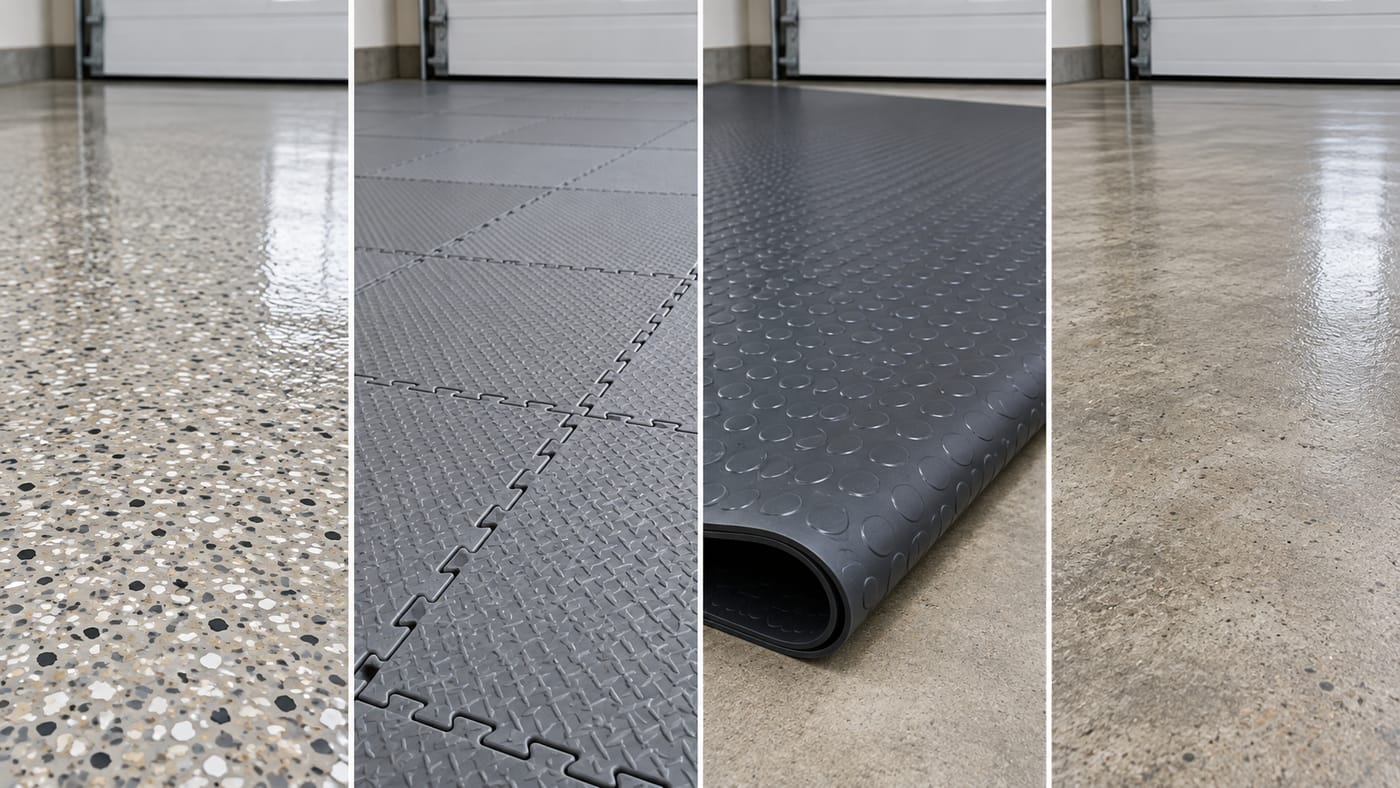
TL;DR
- These four options are not doing the same job. Two of them cover the concrete. Two of them bond to it. That difference decides most of the argument.
- Tiles and mats sit on top of the slab, which means salty meltwater runs underneath and stays there. In a Magic Valley winter that is the wrong place for it.
- A penetrating sealer is a real product with a real use, but it is invisible, it does not fill cracks and it needs redoing every few years.
- Paint is the one to rule out. It peels, it lifts with hot tires, and it needs recoating every year or two.
- Tiles and mats genuinely win in three situations: you rent, you need it reversible, or your slab is in no condition to coat yet.
- For a permanently owned Idaho garage that sees road chemistry every winter, a bonded coating is the one that actually seals the concrete.
The distinction that matters
Before comparing anything, there is one split worth understanding, because almost every difference comes from it.
Tiles and mats are coverings. They sit on the concrete. You can lift them up and the slab is exactly as it was.
Sealers and coatings are treatments. They soak into or bond with the concrete and become part of it. You cannot take them off without grinding.
That sounds like a point in favor of coverings. Reversible, no commitment, no prep. In most climates it is a fair trade. In this one it creates a specific problem, which is the whole reason this article is worth reading.
The quick version
What it is | Lasts | Prep needed | Seals the slab | |
|---|---|---|---|---|
Coating | Bonded epoxy base, flake, polyaspartic clear | Decades with normal use | Full mechanical prep | Yes, with a moisture barrier base |
Tiles | Interlocking PVC or polypropylene squares | Long, and individually replaceable | Clean floor only | No |
Mats | Roll-out vinyl or rubber sheet | Several years | Clean floor only | No |
Penetrating sealer | Silane or siloxane soaked into the concrete | A few years to several, by product | Clean floor | Partially, and invisibly |
Paint | Latex or epoxy-fortified floor paint | One to two years | Clean and etch | No |
Interlocking tiles
What they do well. Tiles install without adhesive over existing concrete, which means no prep, no fumes and no cure time. You can do a garage in an afternoon. They are warmer and softer underfoot than bare concrete, which matters if you spend real time standing out there. If one gets damaged you replace that one tile rather than the floor. And you can take the whole thing with you.
Where they fall down here. Tiles have seams, and seams let liquid through. Water, oil and the salty slush off your tires work down between the tiles and sit on the concrete underneath, where nothing evaporates quickly and nothing gets mopped.
That matters more in Twin Falls than it would in a dry mild climate, because of what is in that meltwater. Idaho road crews run chloride brines all winter, and magnesium chloride in particular attacks the compound that binds concrete together. The chemistry is covered in full here. A tiled floor hides that process rather than preventing it.
Trapped moisture under tiles can also lead to mildew, which is less of a problem in our dry air than it would be elsewhere, but it is not nothing.
The honest summary: tiles protect your eyes from the concrete. They do not protect the concrete.
Roll-out mats
What they do well. Mats are the cheapest fast fix that actually looks deliberate. They roll out, they need no adhesive, they absorb impact and noise, and they come up again whenever you want. For covering a stained slab before a house showing, or giving one bay a defined work area, they do the job.
Where they fall down here. The same trapped moisture problem as tiles, and in some ways worse, because a continuous sheet means whatever gets underneath has no way out at all.
Then there are the practical annoyances. Edges curl and become something to trip over. Heavy or static loads such as a jack stand or a loaded shelving unit leave permanent indentations. And rubber tires sitting on vinyl is its own problem, since the same plasticizer compounds that cause hot tire pickup on cheap coatings can discolor a vinyl mat where the tires rest.
Mats are a temporary answer that some people keep for years. That is fine as long as you know which one it is.
Penetrating sealer
This is the option most often dismissed unfairly, so it is worth being accurate.
A penetrating sealer, usually silane or siloxane based, soaks into the concrete and reacts inside the pores rather than forming a film on top. It makes the slab significantly less absorbent. Some products claim water absorption reductions around 95 percent. Because there is no film, there is nothing to peel, delaminate or lift with hot tires. That is a genuine advantage and it is the reason sealers are specified on highway structures.
The limits are equally real. It is invisible, so your garage still looks like a garage floor. It does not fill or bridge cracks. It does not stop dusting the way a coating does. It does not give you a cleanable non-porous surface, so oil and spills still need attention quickly. And it is not permanent. Depending on the product, reapplication runs anywhere from a couple of years to several.
Where it genuinely makes sense: a slab you do not want to change the appearance of, a budget that will not stretch to a coating this year, or a garage where you want some chloride resistance now and a proper floor later. It is a reasonable holding move. It is not a finished floor.
Paint
Short section, because the answer is short.
Floor paint is cheap and it looks fine for a season. Then it chips, it peels at the door line, and it comes up in patches where warm tires sit. Expect to recoat every year or two, and expect the recoat to be worse than the first one because you are now painting over failing paint.
If a quote you are comparing is dramatically cheaper than everything else, it is worth asking whether what is being sold is a coating system or a paint.
What a bonded coating does differently
The thing a properly built coating does that none of the above do is seal the concrete from both directions while staying attached to it.
That means the slab gets mechanically profiled first, usually by diamond shot blasting, so the coating locks into the concrete rather than resting on it. A one hundred percent solids moisture vapor barrier epoxy goes down as the sealing layer. Flake is broadcast into it. A UV stable polyaspartic clear goes on top as the wear surface. The full build is here.
The result is a continuous non-porous surface with no seams, no edges and nothing underneath it. Chloride lands on it and gets mopped off. Water sits on it and gets squeegeed out. Nothing reaches the concrete.
The honest tradeoffs. It costs more than the alternatives. It is not a DIY job, because the prep is most of the work. It is permanent, so if you want your floor back you are grinding. And it requires the slab to be in reasonable condition first, which is a real conversation rather than a formality. If yours is cracked or badly worn, that gets assessed before anything goes down.
Real cost ranges are on our cost page rather than buried in a comparison article.
So which one
Being straight rather than selling.
Choose tiles or mats if you rent, you expect to move soon, you want it reversible, you want one defined area rather than a whole garage, or your slab needs work you are not ready to do yet. All legitimate reasons.
Choose a penetrating sealer if you want chloride and freeze resistance on a budget, you do not care how the floor looks, and you accept redoing it periodically.
Choose a coating if you own the house, you plan to stay, you want the concrete actually protected from what comes in on your tires every winter, and you want a floor you clean rather than maintain.
Choose paint if you are selling in three months and want it to look tidy. Otherwise do not.
Have your slab looked at before you decide
The right answer depends on the condition of your concrete, which is not something to judge from a photo or an article.
A free in person estimate covers a proper look at the slab, an honest read on whether it is ready for a coating, and a flat written price. No pressure, no gimmicks.
Get My Free Quote · (208) 731-1729
Twin Falls, ID. Serving the Magic Valley including Jerome, Kimberly, Burley and Mini-Cassia, Buhl, Filer, Wendell, Gooding and the Wood River Valley.
Frequently asked questions
Are garage floor tiles bad for concrete? Not inherently, but they do not protect it. Liquid works through the seams and sits on the slab underneath where it does not evaporate and does not get cleaned. In a climate where tires bring chloride home all winter, that is the material point against them.
Can I put tiles or mats over a damaged floor? Yes, and that is one of their real advantages. They cover a slab that is stained, dusty or cosmetically poor without any prep. Just be clear that covering is not repairing, and whatever is happening underneath continues.
Is a penetrating sealer as good as a coating? For different things. A sealer reduces absorption and cannot peel, which is genuinely useful. A coating gives a sealed, cleanable, seamless surface and changes how the garage looks and works. A sealer is not a cheaper version of a coating, it is a different product.
How long does a concrete sealer last before reapplying? It varies widely by product, from a couple of years for some to much longer for others. Acrylic sealers are at the short end, generally one to three years. Plan on reapplication as part of the cost.
Why is floor paint so much cheaper? Because it is a thin film with minimal prep and a short life. It typically needs recoating every year or two, and it is the option most prone to lifting where warm tires sit.
Can tiles or mats be used with a coated floor? Yes. Plenty of people put a containment mat on a coated floor in winter to corral slush into one place. That works because the coating underneath is already sealed, so anything that gets under the mat is sitting on a non-porous surface rather than on concrete.
What if I want to try a cheap option first? That is a reasonable way to buy time, and a sealer or mats will do it. Just account for the fact that the slab keeps aging underneath, and the condition of the concrete is what determines your options later.