• Floor Coatings
Can You Coat a Cracked or Old Garage Floor?
TL;DR
- Usually yes. Most cracked garage floors can be coated. Most cracks in a residential slab are shrinkage cracks from curing and are cosmetic.
- Width is the wrong measure. The quarter-inch rule repeated online does not appear in federal or standards documents. A wide dormant crack is often simpler than a narrow moving one.
- What matters is movement. A rigid repair in a crack that is still moving relocates the problem instead of fixing it.
- Old slabs usually clean up better than expected. Diamond shot blasting removes the weak, dusty top layer as part of prep.
- Moisture decides more than looks do. A crack-free slab can still be a poor candidate if water is pushing up through it.
- You can test it yourself. Mark the crack, date the marks, check after a season change.
Most cracks are normal
Concrete shrinks as it cures, and shrinkage cracks are the result. They are common in residential slabs across the Magic Valley and they rarely indicate anything structural.
The Federal Aviation Administration describes a non-structural shrinkage crack by what it looks like rather than how wide it is: hairline, usually only a few feet long, not running across the entire slab, formed during setting and curing, and typically penetrating no more than a quarter inch below the surface.
Worth knowing that the quarter-inch rule you will find repeated online, the one that says any crack wider than a quarter inch is structural, does not actually appear in the federal or standards documents. Width alone is a weak signal. It gets quoted because it is easy, not because it is right.
You should also not mistake control joints for cracks. Those are the straight scored lines cut into the slab in a grid, sometimes with a thin plastic strip in them, and they exist to give the concrete a controlled place to crack. They are supposed to be there, and they get handled deliberately during a coating rather than treated as damage.
The question that actually matters: is it moving
A dormant crack has finished doing what it was going to do. An active crack is still moving, usually because something under the slab is moving too.
This distinction decides everything, because a rigid repair in a moving crack does not hold. The US Army Corps of Engineers is direct about it: filling a crack in a still-contracting slab with a high-strength material such as epoxy will only cause new cracking. Epoxy is stronger than the surrounding concrete, so the slab simply cracks somewhere else instead.
That is why nobody competent will tell you what your floor needs from a photograph. A hairline crack and a moving crack can look identical in a picture.
How to check it yourself
There is no consumer instrument for this, but there is an observation you can make, and it costs nothing.
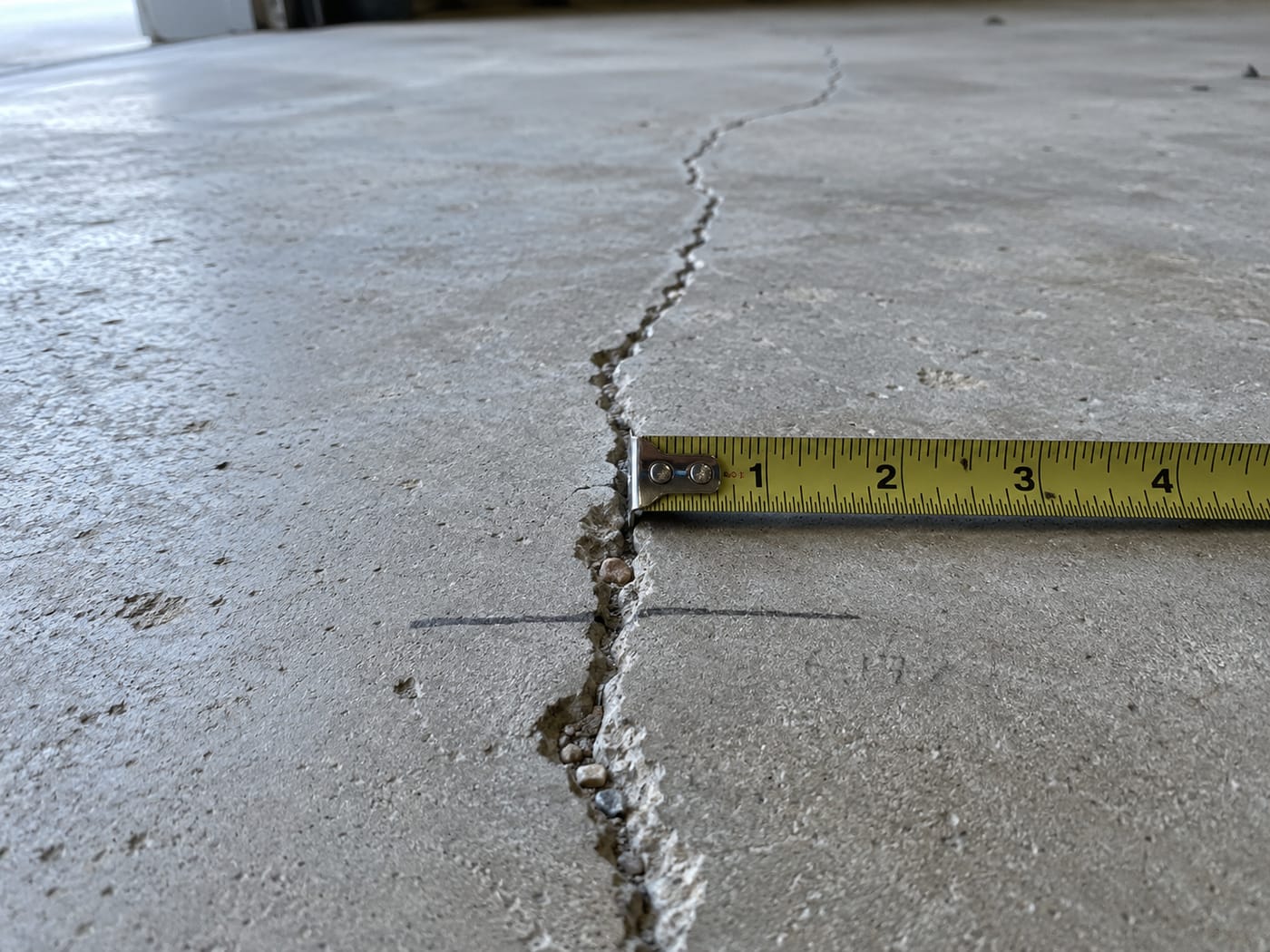
Mark it and wait. Draw a line across the crack in two or three places, mark the date next to it, and look again after a season change. Concrete moves with temperature and moisture, so a crack that is going to move usually reveals it across a hot spell or a cold one.
This works particularly well here. Twin Falls swings from winter lows in the twenties to summer highs near ninety, so a Magic Valley slab gets a thorough test of its own accord within a few months.
Check for displacement. Lay a long level or a straightedge across the crack and sight along it. If one side sits noticeably higher than the other, that is a settlement signal rather than a cosmetic one, and it means something below the slab has moved.
Photograph and date it. A close-up and a wider shot. If you are getting quotes later, being able to show that a crack has or has not changed over three months is genuinely useful information.
What warrants a closer look
Regardless of width, treat these as reasons to have someone assess the slab properly:
- A crack that runs across the entire slab
- A crack that continues down an edge or around a corner
- A visible height difference between the two sides
- A crack that is clearly growing
- Water or soil pushing up through it
- Several parallel cracks running the width of the floor
None of these means the floor cannot be coated. They mean the cause gets identified first, because coating over active movement just hides it for a season.
Old slabs: the other half of the question
Cracks are one issue. Age and surface condition are another, and in Southern Idaho they are often the bigger one.
An older Twin Falls garage slab has been through decades of freeze and thaw, and decades of road de-icer arriving on tires. Where that shows is not usually cracking, it is surface deterioration: pitting, flaking, a chalky or dusty surface, and aggregate starting to show through. That is spalling, and it has a specific cause, which we covered in what Idaho de-icer does to concrete.
Light surface deterioration is normal on an old floor and is generally not a barrier. Deep deterioration, where the top layer has broken down well below the surface, is a different conversation, because a coating bonds to whatever it is put on. Bond it to crumbling concrete and you get a coating that leaves with the concrete.
There is a useful thing about prep here. Diamond shot blasting removes the weak surface layer as part of preparing the floor, so a slab that looks marginal often cleans up better than the homeowner expected. It also does the opposite occasionally, and exposes deterioration that was hidden under a sound-looking surface. Either way, you learn the truth during prep rather than after the coating is down. The full process is on our how it works page.
The third factor: moisture
A slab can be crack-free and sound and still be a poor candidate if too much moisture is moving up through it.
That is why moisture gets tested rather than assumed, and it is why our system leads with a moisture vapor barrier epoxy base coat. Water pushing up from underneath is one of the most common reasons a coating fails, and it has nothing to do with how the floor looks.
Older slabs are more likely to have been poured without a vapor barrier beneath them, which makes this worth checking rather than skipping.
Why this needs eyes on it
You may have noticed this article does not tell you whether your floor can be coated. That is deliberate, because it is not answerable at a distance.
Crack width does not settle it. A photograph does not settle it. What settles it is looking at the crack pattern, checking for displacement, testing moisture and assessing how sound the surface actually is. That takes twenty minutes in person and it is part of a free estimate.
An honest assessment sometimes concludes that something needs addressing before a coating goes down. That is a better outcome than a coating applied over a problem, which costs you the price of the floor and the problem is still there.
Get the slab looked at
If you have an older floor, cracks you are unsure about, or surface that has started to break down, the useful next step is having someone stand in the garage and look at it.
A free in person estimate covers the slab assessment, moisture included, and a flat written price for what your floor actually needs.
Get My Free Quote · (208) 731-1729
Twin Falls, ID. Serving the Magic Valley including Jerome, Kimberly, Burley and Mini-Cassia, Buhl, Filer, Wendell, Gooding and the Wood River Valley.
Frequently asked questions
Are cracks in a garage floor normal? Yes. Most residential slabs develop shrinkage cracks within the first few years as the concrete cures. They are common and usually cosmetic.
How wide is too wide to coat over? Width is the wrong measure. A wide dormant crack can be more straightforward than a narrow active one. What matters is whether it is moving, whether there is displacement, and whether the surrounding concrete is sound.
How do I know if my crack is active? Mark it across the width in a few places, date the marks, and check after a season change. In an Idaho garage the temperature swing between winter and summer is a genuine test.
My floor is old and dusty. Is it too far gone? Probably not. A chalky, dusty surface is often just a weak top layer, and shot blasting removes that as part of prep. Deep deterioration is a different question and needs assessing in person.
Should I fill the cracks myself before you come out? No. Come and look at it first. A repair done with the wrong material for the crack type creates more work, not less, and knowing what the crack was doing beforehand is useful information.
Do control joints get filled? They get handled deliberately, either filled with an appropriate flexible material or left visible as part of the finished look. They are not damage and they are not ignored.
Does an old floor cost more to coat? It can. Slab condition is one of the four things that move a quote, alongside size, finish and how many coats are in the system. More prep or more surface work means more labour. The cost guide covers the ranges, and your number comes from the on-site look.