• Floor Coatings
What Idaho Road Salt Does to a Garage Floor
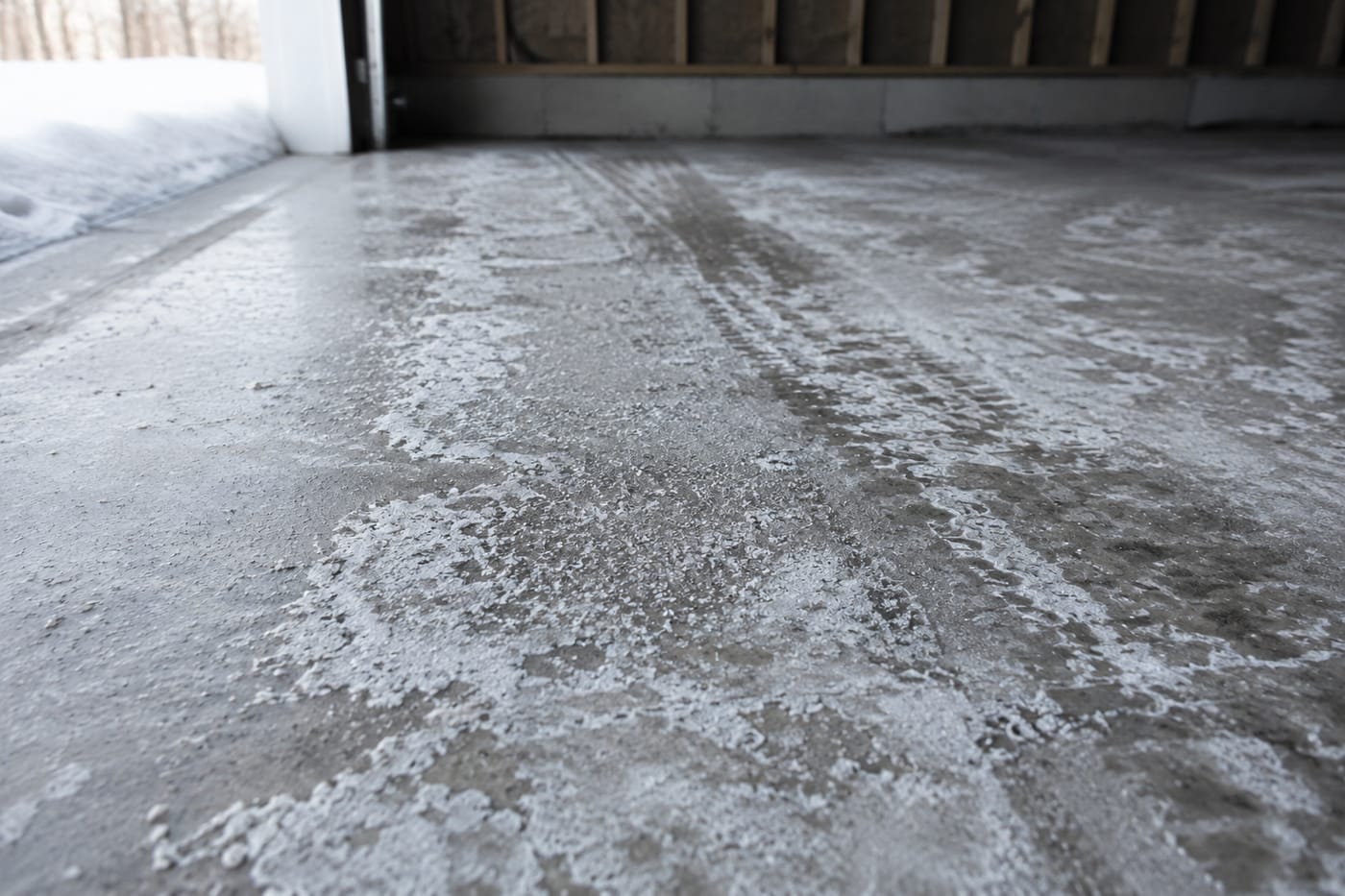
Every winter, your tires carry road de-icer off Idaho highways and into your garage, where it melts off and soaks into bare concrete. Most of what gets used is chemically harmless to a slab. One common ingredient is not.
Magnesium chloride attacks the compound that holds concrete together. Combine that with a Twin Falls winter that crosses the freeze point most days, and a bare garage slab is being worked on from two directions at once.
Here is what is actually happening under your vehicle, and what changes when the floor is sealed.
What Idaho crews are putting on the road
The Idaho Transportation Department uses several products, and which one you drive through depends on where you are and what the weather is doing. Their materials include sodium chloride, magnesium chloride and calcium chloride, applied as granular salt or as liquid brine.
The choice is not made statewide. ITD's own guidance leaves it to each foreman for the roads they are responsible for, and notes that it can vary even inside a single district because topography, elevation and local weather change from one stretch of highway to the next. Their example is specific and useful to us: how they treat highways in Blaine County can be quite different from how they treat those around Twin Falls.
Salt brine is the everyday workhorse in much of the state. Magnesium chloride tends to come out when it gets genuinely cold, roughly 16 degrees and below, because brine stops performing at those temperatures.
That is why this matters more at elevation. In the Wood River Valley, ITD District 4 has been using liquid chloride de-icers for over twenty years, and has moved from a six-to-one sand-to-salt ratio to three to one, with highways now often treated with straight de-icing product rather than a sand mix.
So a Hailey or Ketchum commuter is bringing home a different and heavier chemical load than someone driving Twin Falls to Kimberly. Same state, different exposure.
Why magnesium is the one that matters
This is the part most people get wrong, including plenty of contractors.
Sodium, potassium, and calcium chlorides are essentially inert toward concrete itself. They contribute to freeze and thaw damage, and they corrode steel, but they do not chemically dissolve the slab.
Magnesium does.
Concrete gets its strength from calcium silicate hydrate, the binder that glues the sand and aggregate into a solid mass. When magnesium chloride brine soaks into the pores, magnesium ions react with that binder and convert it into magnesium silicate hydrate, also called brucite. Brucite is not cementitious. It does not bind anything.
In plain terms, the glue turns into powder. The aggregate is still there, but what was holding it together is not, and the surface begins to crumble. Laboratory and field research has also identified magnesium oxychloride and other expansive compounds forming in the same reaction, which push the concrete apart from inside as they grow.
The Iowa Department of Transportation funded a study on this and concluded that magnesium from any source, including road de-icers, plays a major role in highway concrete deterioration.
Worth knowing: that research reversed the earlier assumption. Magnesium chloride was originally adopted partly because several studies suggested it was safer for concrete than rock salt. The chemistry turned out to be more complicated. Some of the most detailed criticism has come from Peter Snow, a concrete specialist at Burns Concrete in Idaho Falls, which is to say from someone who works with Idaho concrete in Idaho conditions.
Then winter does the rest
Chemical attack is only half of it.
De-icer brine does not freeze on top of your slab. It soaks into the pores and capillaries first. When the temperature drops again, that liquid freezes inside the concrete and expands, and the pressure fractures the surface from within. That is spalling, the flaking and pitting you see on older driveways and garage aprons.
As the water evaporates, dissolved salts recrystallise just below the surface and build up over time, adding more internal pressure with every cycle.
This is why Twin Falls is a harder environment than the raw temperature suggests. Our winter averages run near 34 degrees for highs and 24 for lows, which means the slab is not sitting frozen all season. It is crossing the freeze point over and over, and each crossing is another cycle.
Cold alone is not the problem. Cycling is the problem, and we have a lot of it.
Your garage gets a stronger dose than the road
Highways get rain, snowmelt, and runoff washing chloride away. Your garage does not.
The de-icer arrives stuck to tires, wheel wells and undercarriage, melts off in a warmer enclosed space, and the water evaporates while the salt stays behind. Nothing rinses it. Every trip through treated roads adds another layer to what is already there.
That is why the concentration on a garage slab can end up higher than on the road that supplied it, and why the damage often shows first in the parking area and just inside the door.
If your floor is already coated, this is a cleaning task rather than a structural one, and the routine is in our garage floor care guide.
What a sealed floor changes
The point of a properly built coating is that the chloride never reaches the concrete. It sits on a non-porous surface until you mop it up, and it is gone.
That works only if the system is built to keep moisture out from both directions. In our floors, that means the slab is diamond shot blasted so the coating bonds into the concrete rather than sitting on it, then a hundred percent solids moisture vapor barrier epoxy base goes down as the sealing layer, then a UV-stable polyaspartic clear on top as the wear surface. The base coat is the one doing this particular job. The full build is on our how it works page.
There is a legitimate objection worth raising here, because you will read it elsewhere. A film-forming coating over a slab with a moisture problem can trap water underneath and fail, and some people conclude from this that a penetrating sealer is the safer choice. The objection is fair, and the answer is the moisture vapor barrier. A coating applied without one, over concrete that was never properly profiled, is exactly the floor that blisters and lifts. That failure is a prep and specification failure, not proof that coatings do not work.
What a coating does not do
Being straight about the limits.
It does not repair damage already done. If your slab is spalling, pitted, or crumbling, that gets assessed and addressed before anything goes over it. Coating over failing concrete just hides it for a while.
It does not mean you can ignore the floor. Chloride still lands there, and it still needs mopping off; it just is not eating anything while it sits.
And it does not make de-icer harmless to everything else. Your vehicle, your driveway, and your concrete apron are all still exposed.
Common questions
Is magnesium chloride worse for concrete than rock salt? Chemically, yes. Sodium and calcium chlorides do not react with the cement binder, while magnesium chloride converts calcium silicate hydrate into a non-cementitious compound and breaks down what holds the concrete together. Both contribute to freeze and thaw damage, but only magnesium attacks the slab directly.
Does Idaho use magnesium chloride around Twin Falls? ITD uses sodium chloride, magnesium chloride, and calcium chloride across the state, and the specific choice is made locally by each foreman based on conditions. Magnesium chloride is generally reserved for very cold weather where brine underperforms, which makes it more common at elevation than on the valley floor.
Why does my garage floor look white in winter? That pale film is de-icer residue left behind after the meltwater evaporates. On bare concrete it is a warning sign. On a coated floor it is cosmetic, and it mops off with plain water.
My driveway is already flaking. Is my garage next? Not necessarily, since the driveway takes the weather the garage does not. But flaking outside means chloride exposure is real at your address, and the slab inside is getting a concentrated version of the same chemistry without any rain to wash it off.
Is it too late if my slab is already damaged? That depends entirely on how far it has gone, and it is not a question anyone can answer from a photograph. It needs looking at in person.
Get ahead of the season
A slab coated before the first hard freeze spends this winter sealed. A slab left bare spends it absorbing whatever comes home on your tires. The timing on this is worth understanding, because the window closes when the concrete gets too cold to coat.
A free in-person estimate gets your slab looked at properly and a flat written price on paper. No pressure, no gimmicks.
Get My Free Quote · (208) 731-1729
Twin Falls, ID. Serving the Magic Valley, including Jerome, Kimberly, Burley and Mini-Cassia, Buhl, Filer, Wendell, Gooding and the Wood River Valley.