• Floor Coatings
Hot Tire Pickup: Why Garage Floors Peel
TL;DR
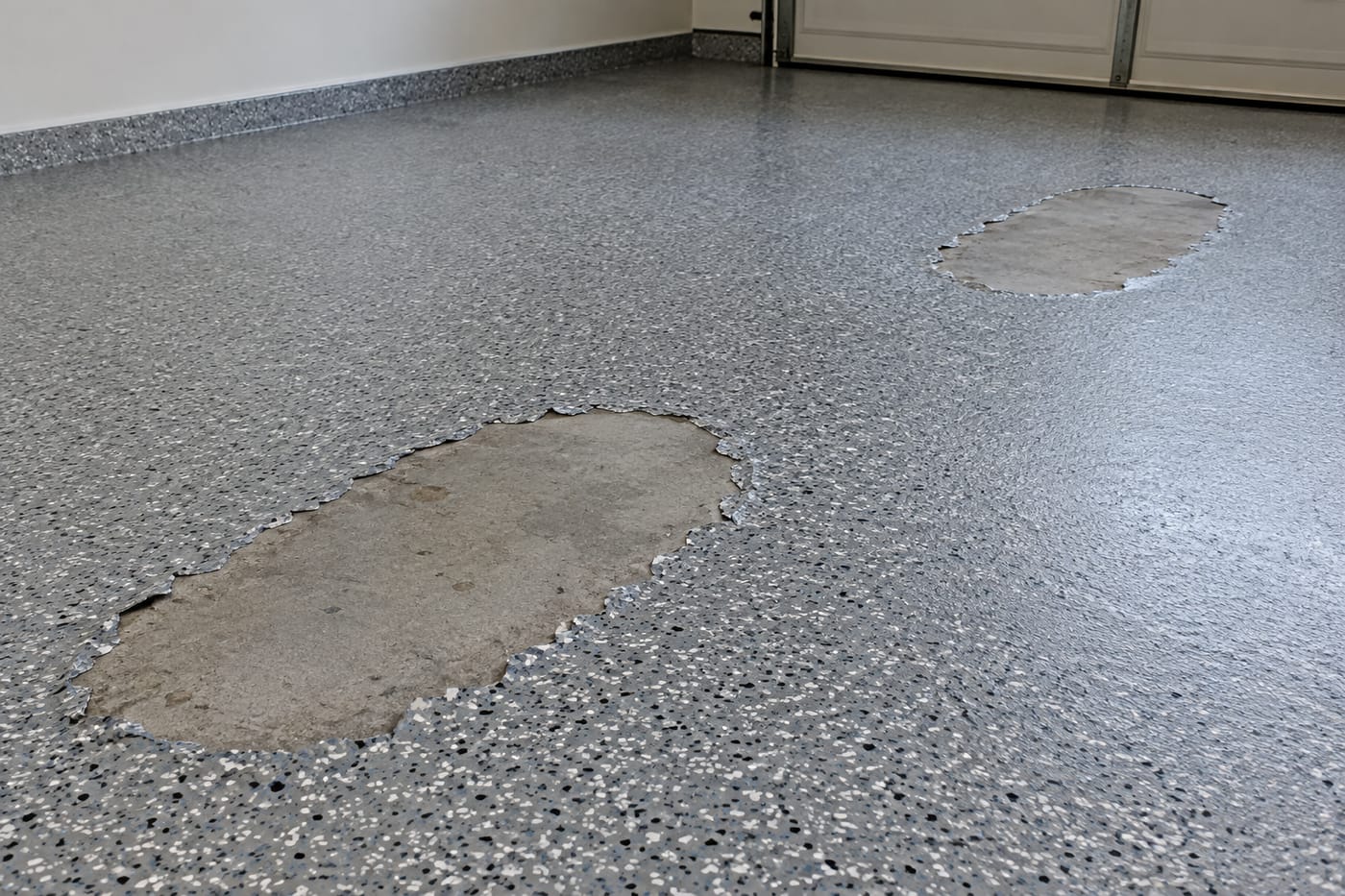
- The damage is unmistakable. Bare patches in the exact spots your tires sit, while the rest of the floor looks fine.
- It is not only heat. Hot tires release plasticizers and paraffin oils that soften a weak coating chemically, like a mild paint stripper.
- The tire then bonds to the softened film and lifts it when you drive away.
- Three causes, in order: inadequate prep, a low-solids coating, and parking on a floor before it has cured for vehicles.
- Walk-on time is not drive-on time. A coating can feel dry and still be days from chemically hardened.
- A properly built system does not do this. High-solids two-part chemistry over a shot blasted slab has nothing to soften.
What it looks like
You will know it when you see it. The floor is intact across most of the garage, and then there are bare or lifted patches exactly where the tires rest, usually two or four of them, often roughly tire shaped. Sometimes the coating comes away in sheets stuck to the rubber. Sometimes it is just a dull, tacky, discoloured patch that has started to let go.
The giveaway is the pattern. Moisture failures show up randomly across a slab. Prep failures often start at edges. Hot tire pickup shows up where you park, and nowhere else.
Most of it appears within the first six to twelve months of a cheap coating going down, and in Southern Idaho it tends to surface at the end of summer.
What is actually happening
The common explanation is that hot tires melt the coating. That is close, but it misses the part that matters.
Tires get hot from friction. After a highway run, internal tire temperatures climb well above ambient, and that heat transfers straight into whatever the tire is parked on.
Heat alone would be survivable. The problem is what the heat releases. Tire compounds contain plasticizers, which keep the rubber flexible, and paraffin waxes, which protect against ozone and stop the rubber cracking. When a tire heats up, those compounds migrate to its surface.
Sitting against a coating, they act as a solvent. They soften the film chemically, not just thermally. One installer describes the effect as a mild paint stripper, which is a fair description of what is happening at the contact patch.
So the tire softens the coating, cools, and bonds to it. When you reverse out, the bond between rubber and softened coating is stronger than the bond between coating and concrete, and the floor loses.
Why some floors do this and others never do
Three things decide it.
Prep
A coating holds on mechanically, by flowing into the texture of the concrete and locking in. If the slab was acid etched or simply cleaned rather than mechanically profiled, the grip was never there. Hot tire pickup is often just the first thing that finds that weakness.
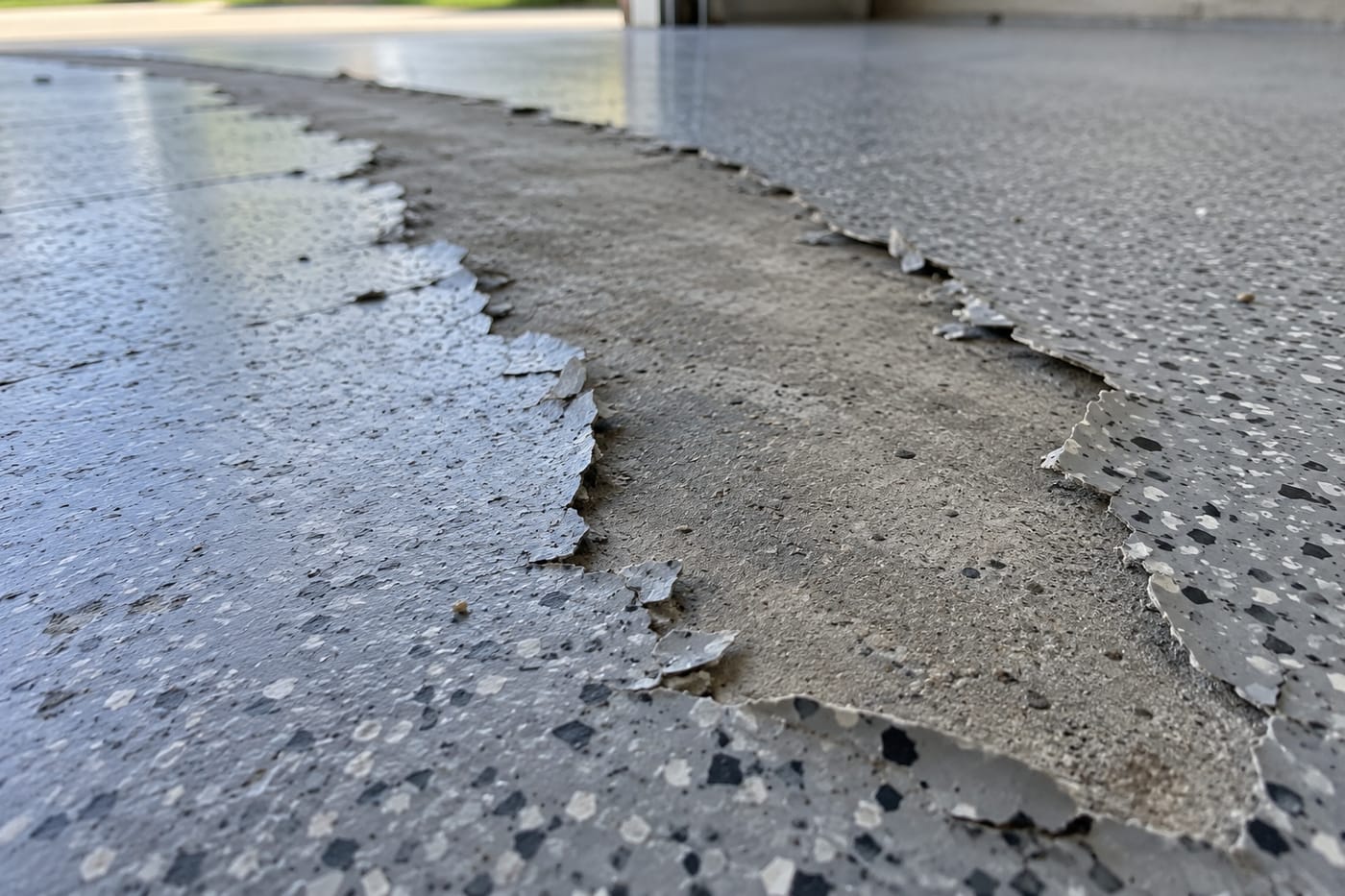
There is a second prep issue people miss. Where a car has parked on bare concrete for years, tire residue and paraffin have already soaked into the slab. Silicone tire dressing is worse, because overspray on concrete acts like a sealer and nothing bonds to it afterwards. That contamination has to be physically removed, which is one of the things shot blasting does and acid etching does not.
The coating itself
Big-box kits are usually water-based, single-component products with low solids content. They cure to a film that is hard enough to walk on and soft enough to give up under sustained heat and pressure.
Two-part, high-solids systems cure through chemical cross-linking into a much harder and more heat-resistant film. The difference is invisible on day one. It shows up in August of the first year.
This is also why a full system matters rather than a single product. A moisture vapor barrier epoxy base bonded into prepared concrete, flake broadcast into it for thickness and body, then a polyaspartic clear on top as the wear layer. That build is on our how it works page.
Parking too early
This one causes failures on otherwise good floors.
Coatings cure by chemical reaction, and dry to the touch is not the same as cured. A floor can take foot traffic the same evening and still be days away from being ready for a four thousand pound vehicle with warm tires. Park too soon and you get the exact failure the system was designed to resist.
Follow the vehicle cure time your installer gives you, not the walk-on time, and not a number from the internet.
The Idaho version of this problem
Twin Falls hits highs near 90 in summer with around 210 sunny days a year, and a lot of garage driving here involves real distance. A run up the interstate or out across the valley puts genuine heat into tires before they ever reach your garage.
There is also the sun itself. An open garage door in July puts direct light on the slab, and a floor that is already warm has less margin when a hot tire parks on it.
The timing works out badly for cheap floors. A coating installed in spring gets through its first few months looking fine, then meets its first real summer. By September the patches are showing, which is exactly when people start looking at their garage again before winter.
Worth saying plainly: this is a summer failure, and winter brings a separate set of problems to a bare or failing slab. If a coating has already lifted where you park, the exposed concrete underneath spends the winter taking de-icer directly.
If you already have a good floor
A properly built system does not need protecting from this. Still, two things are worth knowing.
If you run performance tires, or the vehicle sits in one spot for long stretches, parking mats under the tires remove the contact issue entirely. They are cheap and they cost you nothing.
And go easy with silicone tire dressing near the garage. Overspray on a coated floor is a slip risk and does the surface no favours. General care is in our floor care guide.
If your floor is already lifting
Whether a floor with hot tire damage can be recoated depends on how much of the rest of it is still properly bonded, and that is not something anyone can judge from a photo. Sometimes the damage is confined to the parking areas and the rest is sound. Sometimes the patches are simply where a weak bond failed first.
What is worth knowing is that putting fresh coating over a failing one repeats the failure. Whatever goes down next needs to bond to concrete, not to the previous attempt.
That is a twenty minute assessment in person. It is also the same conversation as an old or damaged slab.
Get it looked at before winter
If your floor is peeling where you park, the concrete underneath is exposed heading into de-icer season. A free in person estimate covers the slab, the bond, moisture testing and a flat written price. No pressure, no gimmicks.
Get My Free Quote · (208) 731-1729
Twin Falls, ID. Serving the Magic Valley including Jerome, Kimberly, Burley and Mini-Cassia, Buhl, Filer, Wendell, Gooding and the Wood River Valley.
Frequently asked questions
What is hot tire pickup? It is when a garage floor coating lifts off in the spots where vehicle tires park. Hot tires release plasticizers and paraffin that soften a weak coating, the rubber bonds to the softened film, and driving away pulls it off the concrete.
Does hot tire pickup happen to all epoxy floors? No. It happens to thin, low-solids coatings and to coatings applied over poorly prepared concrete. High-solids two-part systems over a mechanically profiled slab are not vulnerable to it in the same way.
How soon after installation can I park on a new coating? Longer than you can walk on it. Foot traffic is usually fine the same evening, while vehicles typically need considerably longer. Follow the specific vehicle cure time your installer gives you, because it varies with product and temperature.
Will parking mats prevent it? They remove the tire-to-coating contact, so yes, they help. On a properly built floor they are optional. On a thin coating they are a patch over a deeper problem.
Can hot tire pickup be repaired? It depends on whether the rest of the floor is still soundly bonded. Coating over a failing coating recreates the failure, so the answer comes from assessing the bond in person rather than from a photograph.
Does tire dressing damage a garage floor? The silicone in tire dressing can transfer onto concrete and act like a sealer, which stops coatings bonding later. On a finished floor it mostly makes the surface slick. It is worth keeping off the floor either way.
Why did my floor only start peeling after a year? Because the first summer is the test. A weak coating can look perfect through cooler months and fail once tires start arriving hot.