• Lighting & Audio
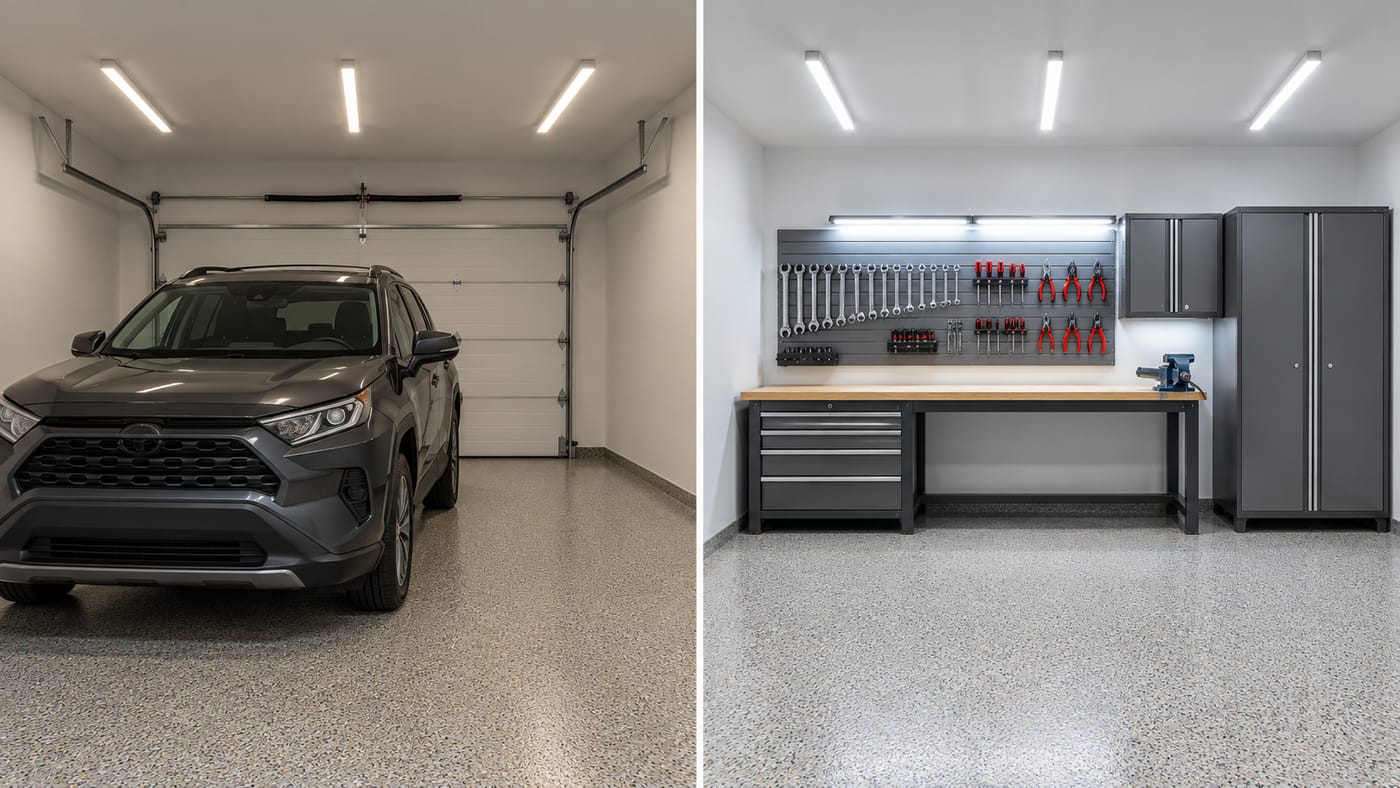
Lighting a Workshop vs Lighting a Parking Bay
TL;DR
- They are two different jobs. A parking bay needs even light and no dark corners. A workshop needs roughly twice as much, plus accurate color and shadow control.
- Most garages are both, and the usual mistake is lighting the whole room to one standard. The bench ends up under-lit or the parking area ends up glaring.
- Rough targets: a storage-only bay of 200 to 250 square feet wants 8,000 to 12,000 lumens. A general workshop of 300 to 400 square feet wants 15,000 to 25,000. An auto repair bay wants 25,000 to 35,000.
- Color accuracy matters at the bench and barely matters at the parking spot. CRI 80 to 89 is the practical minimum for work, 90 or higher for paint matching.
- Layout beats fixture count. Clustering light in the middle of the ceiling is why garages feel dim even after an upgrade.
- In an unheated Idaho garage, check the cold rating. Standard indoor drivers can fail to start reliably below their tested range.
Why one standard does not work
Nearly every Magic Valley garage does two jobs. Cars go in it, and work happens in it. The trouble is that those two activities want very different light, and most garages get lit as though they only do one.
Light the whole room to parking standards and the bench is too dim to work at properly. Light the whole room to workshop standards and you have spent money flooding a space where a car sits, with glare bouncing off the hood.
The answer is not a brighter bulb. It is two layers doing different jobs.
What a parking bay actually needs
The goals here are modest and specific. You want to see where you are stepping, see what you are carrying, open a car door without guessing, and find something on a shelf without a flashlight.
The target that matters is evenness, not brightness. A single powerful fixture in the middle of the ceiling produces a hot spot under it and shadow everywhere else, which is worse than several modest fixtures spread out.
Around 50 lumens per square foot is the general benchmark for parking and movement. For a typical two car bay used mainly for parking and storage, that lands in the region of 8,000 to 12,000 lumens for a smaller bay, more as the footprint grows.
Color temperature can be neutral here. Around 4000K is a comfortable all-round choice and causes less eye fatigue than something cooler. Color accuracy is not critical, because you are not matching anything.
What a workshop actually needs
This is a different specification.
Much more light. A general workshop wants roughly 15,000 to 25,000 lumens over 300 to 400 square feet. An auto repair bay pushes to 25,000 to 35,000. A woodworking shop sits near the top of its range, 28,000 to 40,000 for 400 to 600 square feet, and the reason is safety rather than comfort. Moving blades and shadows are a bad combination.
Accurate color. CRI describes how truthfully a light source renders color. Below 70 is unsuitable for workshop use. 80 to 89 is the practical minimum for general tasks. 90 or higher is what you want for automotive paint matching or fine finish work. This is the spec most people never look at, and it is the difference between reading a wire color correctly and guessing.
Daylight color temperature. 5000K to 6500K reads as daylight and is the right range for painting, finishing and anything color critical. 5000K is a sensible default for a garage that does real work.
Shadow control. This is the part layout solves rather than wattage. Light coming from one direction means your own hands and body cast a shadow exactly where you are working. Fixtures with diffusing lenses soften that, and light arriving from more than one angle largely removes it.
A dedicated bench fixture. Ambient ceiling light alone will not do it. A separate fixture of at least 4,000 lumens, mounted roughly 18 to 24 inches above the work surface, is what makes a bench genuinely workable.
The layout mistake almost everyone makes
The most common error is not buying dim fixtures. It is buying too few and putting them in the wrong place.
Fixtures clustered near the center of the ceiling light the middle of the floor and leave the perimeter, where the shelves and the bench usually are, in relative gloom. Spreading the same fixtures out produces a better result with no extra cost.
As a rough guide, linkable strip fixtures want to be around 4 to 6 feet apart to avoid visible dark bands between them. In a larger space, rows roughly 8 to 10 feet apart work better than a cluster.
Mounting height matters too. On a ceiling of 8 feet or under, flush mounting is fine. On 10 feet or higher, hanging the fixture down brings it closer to the work surface so less output is wasted on the ceiling. Add roughly 20 percent to your lumen target for a high ceiling, and again for dark walls or heavy shelving that absorb light rather than bouncing it.
One practical note on linked runs. Most linkable fixtures cap at three or four units per run before voltage drop becomes a problem, so a long garage usually needs more than one circuit feed rather than one very long chain.
The Idaho layer
Two things that matter here and get skipped in national advice.
Cold rating. An unheated Magic Valley garage sits close to outdoor temperature, and winter lows here run into the low twenties and occasionally below. For a garage like that, choose fixtures rated to roughly minus 4 Fahrenheit or lower. Standard indoor-rated drivers can fail to start reliably when they are below their tested range, or wear out faster if they do. This is the single most common complaint about shop lights in cold climates, and it is a spec you can check before buying rather than discover in January.
Short winter days. Twin Falls gets around 210 sunny days a year, and in summer an open garage door does a lot of the lighting work for you. In December it does none. Anyone who gets home after five between November and February is walking into a garage with no natural light at all, which is exactly when people notice their lighting is inadequate.
And the floor matters more than people expect. A light or mid tone coated floor bounces light back up into the room. Bright fixtures over a dark stained slab give you roughly half the room you paid for, which is one of the reasons the finish you choose interacts with the lighting plan.
What ceiling lighting cannot fix
Worth being straight about this.
No ceiling layout solves working under a vehicle. The car blocks the light. That is a portable work light or an underhood light, and no amount of overhead fixtures changes it.
Similarly, deep cabinet interiors stay dark regardless of what is on the ceiling. If that bothers you, the answer is under cabinet lighting rather than more ambient output.
Knowing what a ceiling plan will and will not do saves money and disappointment.
Plan the layers together
The garages that work well have an ambient layer across the whole space and a brighter task layer where real work happens, wired so you can use one without the other.
That is easiest to get right when the lighting is planned alongside the storage layout, because where the cabinets and bench end up determines where the task light needs to be. It is also easier when wiring is routed during a renovation rather than added afterward.
A free in person estimate covers measuring the space, working out the layers for how you actually use the garage, and a flat written price. No pressure, no gimmicks.
Get My Free Quote · (208) 731-1729
Twin Falls, ID. Serving the Magic Valley including Jerome, Kimberly, Burley and Mini-Cassia, Buhl, Filer, Wendell, Gooding and the Wood River Valley.
Frequently asked questions
How many lumens do I need in my garage? It depends on what happens in it. Around 50 lumens per square foot covers parking and movement. A general workshop wants noticeably more, roughly 15,000 to 25,000 lumens across 300 to 400 square feet, and an auto repair bay more again.
What color temperature is best for a garage? Around 4000K is a comfortable neutral for general use. 5000K reads as daylight and is the better choice for a garage where real work happens, including anything color critical.
What is CRI and does it matter? Color Rendering Index describes how accurately a light shows color. Below 70 is not suitable for workshop use, 80 to 89 is the practical minimum, and 90 or above matters for paint matching and fine finish work. For a pure parking bay it matters very little.
Why is my garage still dim after I added new lights? Usually too few fixtures, or fixtures grouped too close to the center of the ceiling. Spreading the same output across the space, and adding roughly 20 percent for a high ceiling or dark walls, generally fixes it.
Do LED shop lights work in a cold garage? Good ones do, but check the rating. For an unheated garage here, look for fixtures rated to around minus 4 Fahrenheit or lower. Standard indoor drivers can struggle to start reliably when it is colder than they were designed for.
Do I need a separate light over my workbench? If you do anything detailed there, yes. Ambient ceiling light leaves your own shadow on the work. A dedicated fixture of at least 4,000 lumens mounted 18 to 24 inches above the surface makes the difference.
Can lighting be added without a full renovation? Yes, lighting can be done on its own. It is simply cheaper and tidier when it is planned alongside storage and wiring, because the runs can be routed behind the build rather than across it.