• Floor Coatings
Open Shelving vs Cabinets in an Idaho Garage
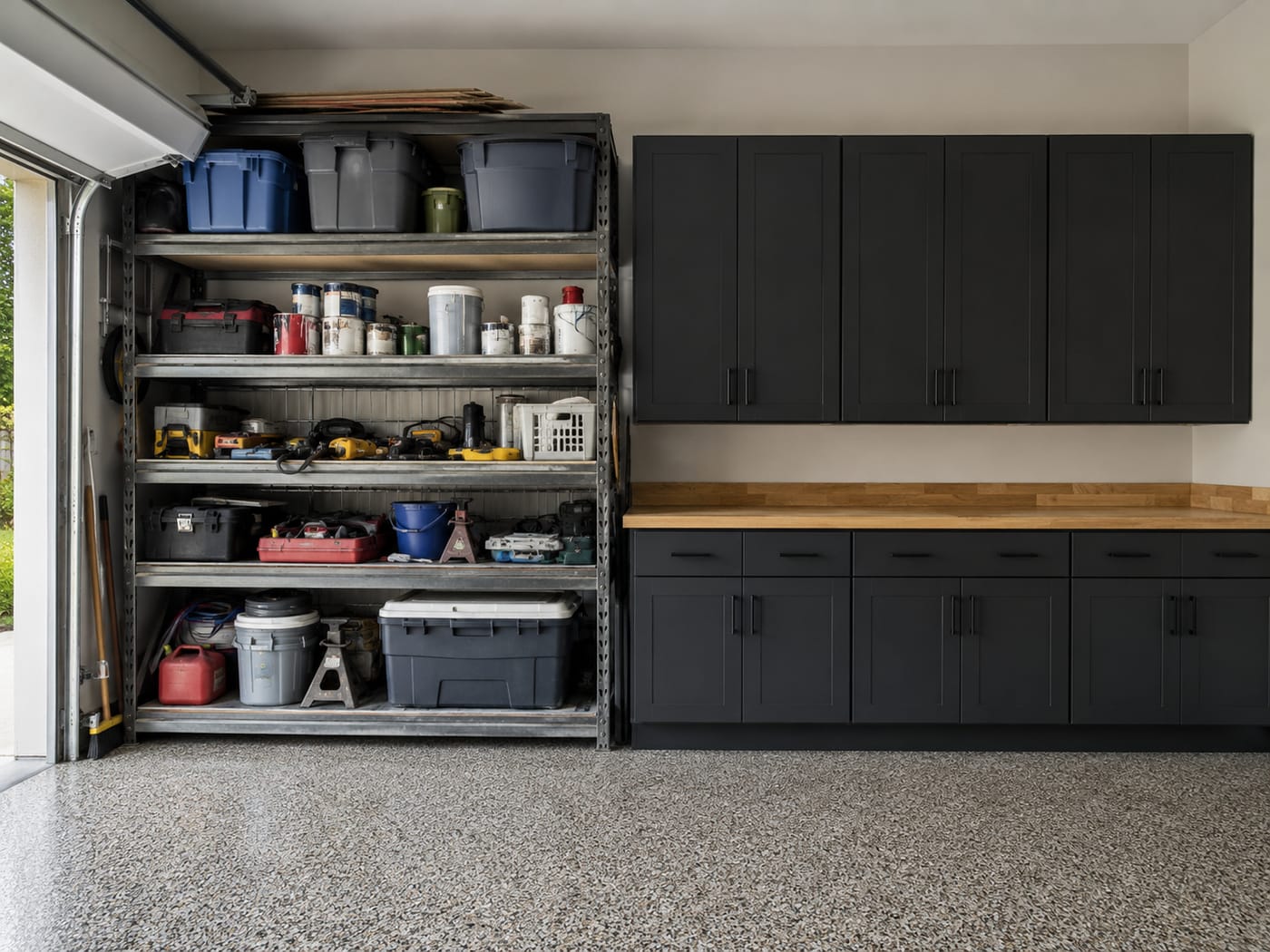
In a Magic Valley garage, most of what you own belongs behind doors. Open shelving is cheaper and easier to reach into, but a garage here collects fine high desert dust for nine months of the year and road grit and salt for the other three, and open storage collects all of it.
That does not mean everything gets a cabinet. Some things should be out in the open, and some should be overhead. Here is how to decide.
What an Idaho garage does to your stuff
Storage advice written for a climate-controlled space does not transfer here, so start with the conditions.
Dust is constant. The Magic Valley is high desert. Fine, pale dust gets in around door seals and settles on every horizontal surface. On an open shelf it lands directly on whatever you stored there. On a cabinet it lands on the cabinet top, where you can wipe it off.
Winter brings grit and salt. Road de-icer and sand come home on your vehicle, get walked around the garage, and end up on low shelves and floor-level storage. Anything metal that sits in that environment corrodes faster than it should.
Temperature swings are large. An unheated garage here can run near freezing in January and well above ninety in July, with big day-to-night swings on top of that. Paint, adhesives, some cleaning products, batteries and anything with a rubber seal all age faster.
Humidity is low but not zero. Dry air is kind to tools. Meltwater off a vehicle in February is not, and it pools exactly where you park.
None of this is a reason to avoid storing things in the garage. It is a reason to be deliberate about which things go where.
The honest case for open storage
Open shelving and wall systems have real advantages and it would be dishonest to pretend otherwise.
They are cheaper per foot. They are faster to install. You can see everything at once, which matters for things you reach for constantly. And they are easy to reconfigure when your needs change.
Where they genuinely win is high-frequency, low-value items that you handle often and that do not care about dust. Lawn and garden tools. A broom and a shovel. Bulk items you cycle through quickly. Sports gear that lives outside anyway.
Where they lose is everything else. Open storage is also the reason garages look cluttered even when they are organised, because you are looking at every object you own at the same time.
The case for doors
Closed cabinets do four things open shelving cannot.
They keep dust off. This is the practical argument, and in this climate it is the main one. Anything you want clean when you next pick it up belongs behind a door.
They hide visual clutter. A wall of cabinet fronts reads as a finished room. The same wall in open shelving reads as storage, no matter how neatly it is arranged. This is most of why a renovated garage looks renovated.
They contain the mess. Open shelves invite piling. A closed cabinet has a fixed volume, and when it is full you deal with it rather than stacking higher.
They secure things. Chemicals, power tools and anything you would rather children not reach go behind a door, and lockable options exist.
Garage Pro's Signature Cabinets are built on this logic. The point of the line is getting things off the floor and out of sight, not just off the floor.
What belongs where
The system that works is zoning by how often you use something and how much it minds the environment.
Behind doors: power tools, hand tools, car care products, paint, chemicals, anything with a motor or a battery, anything you want clean, anything you want out of reach.
Open and within arm's reach: the three or four things you touch every single day. A broom. Work gloves. Whatever your household actually reaches for without thinking.
Overhead: long-term seasonal storage you touch twice a year. Holiday decorations, camping gear, luggage, summer or winter equipment in its off season. This is the dead space above the garage door and along the ceiling, and in most garages it is completely unused.
On the floor: as little as possible. The floor is for vehicles. Everything that lives on the floor is something you move to sweep, and something that eventually stops you parking inside.
Not in the garage at all: anything that genuinely cannot handle the temperature swings. Latex paint that has already been through a freeze, some electronics, certain adhesives, and food or pet food that attracts pests.
Why the mess comes back
Most garages get organised, stay organised for a few months, and then slide back. That is not a discipline problem, it is a design problem.
The usual cause is that everything has a place in theory but not a specific place in practice. If putting something away takes more effort than setting it down, it gets set down. Open shelving makes this worse, because the shelf accepts anything at any height and there is no signal that it is full.
The fix is fewer, better-defined homes for things, and enough closed volume that the default action is putting something in rather than on.
Sequence matters: floor first
If a coating is anywhere in your plans, it goes down before any storage is installed.
Cabinets, shelving and overhead racks all get set and levelled on a finished floor. Doing it the other way means the coating crew works around obstacles and coats up to edges, which is slower, costs more and leaves visible stopping points.
It is also worth choosing the cabinet finish and the floor finish in the same conversation rather than a year apart. Ten feet of cabinet face is a lot of colour, and the two decisions look like one decision when they are made together. There is more on timing a renovation if you are planning the order of a larger project.
Common questions
Is open shelving a bad idea in a garage? Not bad, just limited. It works well for a small number of frequently used items that do not mind dust. For everything else, doors are worth the difference, particularly in a dusty high desert climate.
Do I need cabinets if I already have a workbench? A workbench without storage tends to become a shelf. The bench works best when the things you use on it have somewhere to go the moment you are finished.
How much weight can overhead racks hold? That depends entirely on the rack and, more importantly, on what it is fixed into. Overhead storage has to be lag-mounted into ceiling framing, not into drywall. Capacity is specified per product and confirmed at install, and it is not something to estimate.
Can I add storage later instead of all at once? Yes, and plenty of people do. Bundling generally costs less because each separate visit carries its own setup and cleanup, but phasing works fine as long as the floor goes first.
What should I not store in an unheated Idaho garage? Anything that has already frozen once and separated, most latex paint through winter, some electronics and batteries, and food or pet food. When in doubt, check the product label for a storage temperature range.
Plan the whole wall at once
Storage works better when it is designed around what you actually own rather than bought piece by piece. A free in person estimate covers measuring the space, working out what needs doors and what does not, and a flat written price.
Get My Free Quote · (208) 731-1729
Twin Falls, ID. Serving the Magic Valley including Jerome, Kimberly, Burley and Mini-Cassia, Buhl, Filer, Wendell, Gooding and the Wood River Valley.