• Southern Idaho
Why New Homes in Twin Falls Sit Twice as Long
TL;DR
- New construction in Twin Falls County averaged 131 days on market in May 2026. Resale averaged 58. More than double, in a market where sales were up 20 percent year over year.
- Builders nationally are buying velocity with discounts. Lennar spent the equivalent of 14 percent of final sales price on incentives last quarter, roughly $56,000 on a $400,000 home, against 1.5 percent at the 2022 peak.
- A discount is permanent and public. It closes low, it sets the comp, and every other house in your subdivision inherits it.
- An upgrade is neither. It differentiates the house without touching the price record.
- Buyers care about this specific room. NAHB survey data puts garage storage among the features 80 percent or more of buyers rate essential or desirable.
- A coated floor runs a fraction of one incentive package and it is the first thing a buyer sees when the door goes up.
The number worth looking at
Twin Falls County, May 2026. One hundred and thirty single family homes sold, up 20 percent on the same month last year. Year to date, 550 against 466. Roughly three months of inventory with 389 active listings. By most measures that is a healthy, balanced market.
Then the split. Resale homes averaged 58 days on market. New construction averaged 131.
Demand is not the problem. Buyers are transacting. New builds are simply taking more than twice as long to find them, at a median of $426,995.
Every one of those extra days is carry. Interest, insurance, taxes, utilities, upkeep on an empty house.
What the industry is doing about it
Looking at how the large public builders have responded is instructive, because the scale makes the tradeoff visible.
Lennar spent the equivalent of 14 percent of final sales price on incentives in a recent quarter. On a $400,000 house that is about $56,000. In 2022 the same figure was 1.5 percent.
All eleven major publicly traded builders tracked by ResiClub posted year over year gross margin compression. Unsold completed new home inventory peaked at 134,000 units in December 2025 and had come down to 119,000 by March 2026, partly because builders deliberately cut spec starts and moved toward build to order.
In other words, the industry is buying sales velocity, and paying for it out of margin.
The problem with buying velocity through price
Discounts work. That is why everyone uses them. But they cost more than the discount.
A price cut is permanent. It closes at the reduced number, and that number goes on the record.
It sets the comp. The next house in your subdivision gets appraised against it, and so does the one after that. One aggressive close can reprice the whole phase.
It trains the buyer. A house that has been reduced once invites an offer below the new price.
It is invisible. Nobody walks through and sees the $15,000 you took off. It does not make the house better, more memorable, or easier to choose over the one down the street.
An upgrade does none of that damage. It is spent once, it shows, and it never appears in a price history.
Why the garage specifically
Because it is the only room you deliver unfinished, and buyers notice.
NAHB survey data places garage storage among the thirteen features that 80 percent or more of buyers rate as essential or desirable, alongside a laundry room and a walk in pantry. Buyers say they want it. Almost nobody builds it in.
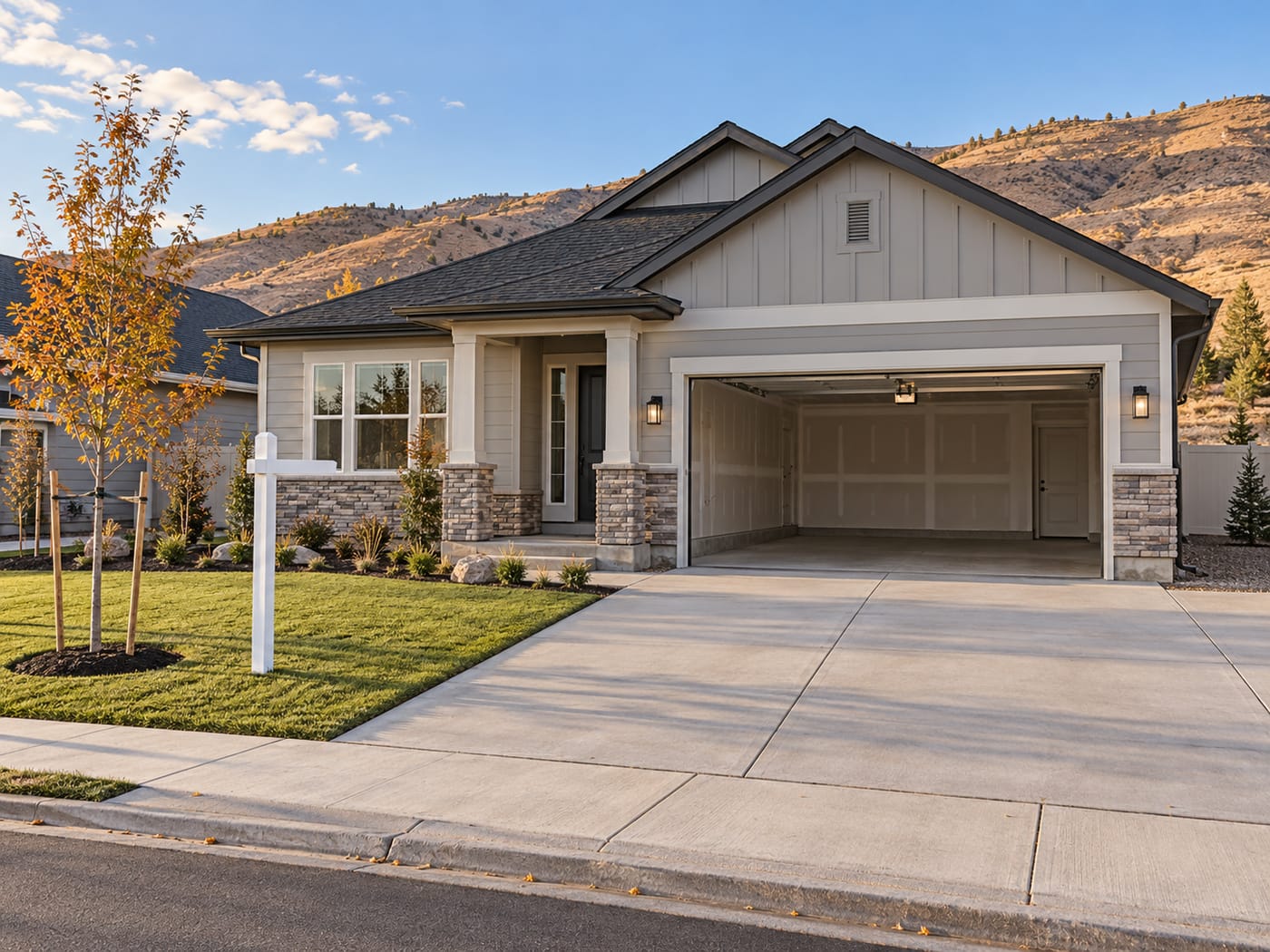
Think about the walkthrough. Every other surface in the house is finished. Flooring, counters, tile, paint, fixtures. Then the garage door goes up and it is a bare broom finish slab and unpainted drywall.
It is also usually the largest continuous surface in the building, and in a Magic Valley garage it is the one that stains, dusts and absorbs road chemistry from day one.
For a buyer walking three comparable houses in a weekend, a finished garage floor is a genuine point of difference in the room where nothing else differentiates.
The arithmetic
A professionally installed epoxy and polyaspartic floor on a two car garage runs roughly $2,000 to $6,000 in this market, driven by size, slab condition and finish. Three car bays run higher. Real ranges are on our cost guide.
Set that against a single incentive package. On the Lennar comparison, a coated floor is under a tenth of what one house's incentives cost.
And a spec home is the cheapest garage anyone will ever coat. The slab is new, clean, undamaged and completely empty. No repair work, no moving anything, no working around a homeowner's belongings. It is the simplest version of this job that exists, which we cover in more detail for buyers in the new build guide.
One technical point worth knowing at the scheduling stage. New concrete needs a minimum 28 day cure before a coating goes over it, and moisture gets tested rather than assumed. On a normal build sequence the garage slab is poured months before finish work, so this rarely creates a problem. It is worth knowing when you are timing trades.
What this looks like as a standard spec
The builders who get the most out of this treat it as a specification rather than a one-off.
Pick one finish and repeat it. A mid tone flake blend in gray and tan is the safest choice in this climate, because it hides the pale chloride film that comes in over winter and the high desert dust the rest of the year. Neutral also photographs well and does not narrow your buyer pool. There is more on that in the finish guide.
Do the model first. A coated floor in the model does the selling for the whole phase, and it lets buyers see the upgrade rather than read it on a sheet.
Decide whether it is standard or an option. Both work. As a standard it is a differentiator in your marketing. As an option it is margin, and buyers who want it have somewhere to spend.
Sequence it late. The floor goes in after the messy trades and before final clean, so it is not being walked on by everyone with a nail gun.
Working with a local crew
Garage Pro is Twin Falls based and locally owned. Brian is a licensed general contractor, which matters on a jobsite where scheduling and coordination are the real constraints.
For builders specifically, what that means practically: one point of contact rather than a call centre, scheduling that works around your trade sequence rather than a national dispatch queue, and floors, cabinets, storage and lighting available from the same crew if a particular plan calls for a fuller garage package.
We work across Twin Falls, Jerome, Kimberly, Burley and Mini-Cassia, Buhl, Filer, Wendell, Gooding and the Wood River Valley.
Talk to us about your next phase
If you have homes sitting, or a phase coming out of the ground, it is worth a conversation about what a finished garage does to a walkthrough.
We will look at the plans, quote per unit, and give you a flat written number you can put in a budget.
Get a Builder Quote · (208) 731-1729
Twin Falls, ID. Serving builders across the Magic Valley.
Frequently asked questions
Is a coated garage floor worth it on a spec home? It is a small line item against the cost of carrying a house for an extra month, and against the incentives builders are currently paying to move inventory. It also shows, which a price reduction does not.
How long does installation take on a new build? Most garages are a one day install. Foot traffic is generally fine the same evening, with longer before vehicles. On a build schedule it slots in as a single trade day.
Does the concrete need to cure first? Yes. The standard is a minimum 28 day cure, and moisture is tested before coating rather than assumed. On a typical build the garage slab is poured well ahead of finish work, so the timing usually takes care of itself.
Can you handle multiple units in a phase? Yes, and repeat work is more efficient for everyone. One finish specification across a phase means faster scheduling and a consistent look through the subdivision.
What finish should a spec home use? A mid tone flake blend in neutral grays and tans. It suits the climate, hides both winter salt residue and summer dust, appeals broadly, and photographs well for listings.
Should it be standard or an upgrade option? Both work. As a standard inclusion it differentiates every house you build. As an optional upgrade it is margin on the units where buyers choose it. Some builders make it standard in the model and optional elsewhere.
Do you work outside Twin Falls? Yes. We cover the Magic Valley, including Jerome, Kimberly, Burley and Mini-Cassia, Buhl, Filer, Wendell, Gooding and the Wood River Valley.