• Garage Renovation
New Build in Twin Falls? Coat the Garage Floor First
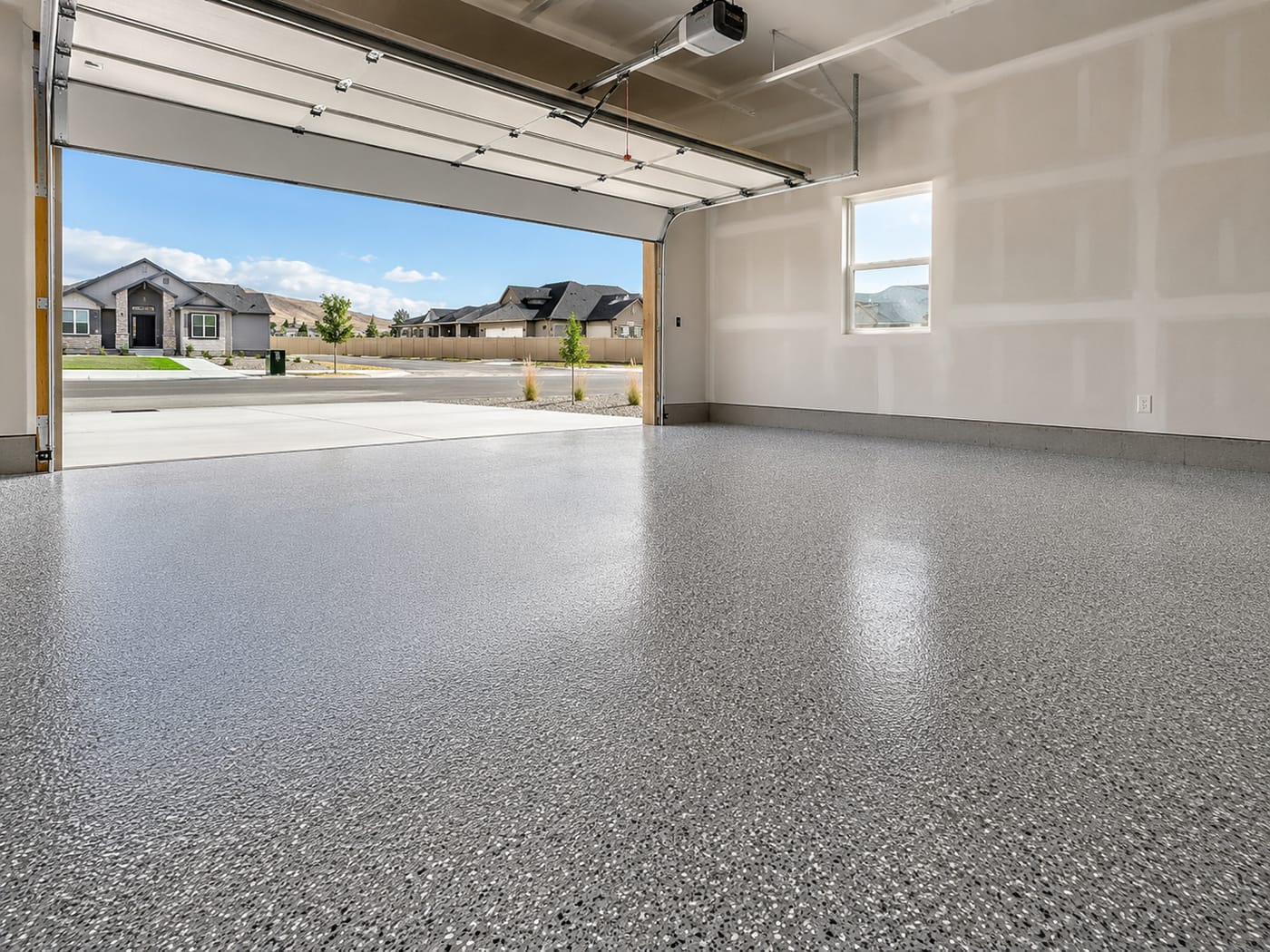
If you are closing on a new build, the window between getting the keys and moving the boxes in is the cheapest and fastest time you will ever have to coat the garage floor. The slab is bare, clean and completely empty, which removes most of the cost and all of the hassle from the job.
There is one thing to check first, and it is the age of the concrete. Everything else is straightforward.
Your new garage floor is the least finished surface in the house
Builders finish the parts buyers walk through. The kitchen gets counters, the bathrooms get tile, the living room gets flooring. The garage gets a broom finish on bare concrete and a coat of paint on the drywall, and that is where the budget stops.
That is not a knock on your builder. It is how the spec is written, and almost every new home in the Magic Valley is delivered this way.
But bare concrete is porous. It absorbs oil, it absorbs water, it stains permanently, it dusts, and it absorbs the road chemistry that comes home on your tires every winter. The garage floor is usually the largest continuous surface in the house and the only one delivered unprotected.
The one thing to check: how old is the slab
New concrete holds a lot of water, and it has to release most of it before anything gets sealed over the top. The industry standard is a minimum 28 day cure, and depending on temperature and humidity it can run to 60.
Skipping that is one of the classic ways a coating fails. The floor looks fine for a few weeks, then moisture pushing up from below breaks the bond and it blisters or lifts.
Here is the part that works in your favour. The garage slab gets poured early in a build, and then framing, roofing, drywall, cabinets and finish work all happen after it. By the time you are at closing, that concrete is usually months old, not weeks. For most buyers this is a non-issue.
The exception is a fast build or a late pour, so it is worth knowing your pour date. And cure time alone is not the whole answer anyway. A slab can be fully cured and still be too wet to coat, which is why moisture gets tested rather than assumed. That is part of any competent estimate and it is not something you have to work out yourself.
Why an empty garage is the cheapest garage
Every item in a garage is something that has to be moved before work starts and moved back after.
In an occupied garage that means shelving units, tool chests, bikes, storage totes, seasonal gear and whatever else has accumulated. Sometimes it means renting a container or clearing space elsewhere in the house. It adds labour, it adds time, and it adds the part homeowners dislike most, which is living around a project.
A new build has none of that. The crew arrives to an empty bay, preps and coats it, and leaves. It is the simplest version of this job that exists.
It also means you never move anything twice. Coat the floor first, then move in on top of a finished surface. Do it in the other order and everything you carefully arranged has to come back out.
The order that saves you money later
If cabinets, shelving or overhead racks are anywhere in your plans, the floor goes first. Always.
Storage gets set and levelled on a finished floor. Do it the other way round and the crew is coating up to edges and working around obstacles, which is slower, more expensive and leaves visible seams where the coating stops.
The same logic applies to a full renovation. Floor, then cabinets and walls, then lighting. Bundling also beats phasing on cost, because each separate visit carries its own setup, prep and cleanup, and you pay that overhead once instead of three times.
The Idaho argument for doing it now
There is a version of this where you wait a year, live in the house, and get to the garage later. Here is what that year costs.
Your first Idaho winter puts road de-icer on that slab. It arrives on your tires, melts off in the garage, and the water evaporates while the chloride stays behind. Nothing rinses it off the way rain rinses a road. Some of what Idaho crews use is chemically harmless to concrete, but magnesium chloride is not, and it attacks the binder that holds the slab together. We covered what de-icer actually does to concrete in more detail.
A slab coated before that first winter never absorbs any of it. A slab left bare spends its first season taking the full dose, and it is a brand new slab, which is exactly what you would want to protect.
Add the oil drips, the stains and the concrete dust of a year of normal use, and the floor you eventually coat is in worse condition than the one you were handed at closing.
Timing it against the calendar
Coatings cure against slab temperature, not air temperature, and an unheated Magic Valley garage is generally too cold from around December through March. The practical window runs late spring through early fall, with September and October being the sweet spot. There is more on why timing matters here.
If you are closing in autumn, book it now rather than after the move. If you are closing in winter, plan it for spring and keep the garage as clear as you reasonably can in the meantime.
What it costs
For a coated floor only, the published Magic Valley ranges are roughly $2,000 to $6,000 for a two car garage and $3,000 to $8,500 for a three car, with the spread driven by size, slab condition and finish. New construction usually sits at the friendlier end, because the concrete is clean, undamaged and needs no repair work before prep.
Full detail is on the cost guide. Your actual number comes from an on-site look at your slab.
While you are thinking about it, finish choice is worth deciding early rather than at the last minute, and there is a guide to colours and finishes that covers what works in an Idaho garage.
Common questions
How long after closing can I coat a new garage floor? Usually right away. The slab needs at least 28 days of cure, and on a typical build it is already several months old by closing because everything above it was built after the pour. Moisture gets tested before work starts either way.
Will coating the floor affect my builder warranty? Coatings are applied over the slab surface and are a normal homeowner improvement, but builder warranties vary. Check your specific documents if you have any concern, and ask your builder rather than assuming.
My builder offered a garage floor coating as an upgrade. Should I take it? Compare the specification rather than the price. Ask what prep is included, whether there is a moisture vapor barrier in the system, how many coats there are and what the warranty actually covers. A cheap builder-grade coating over minimal prep is a common source of early failure.
Can you coat a garage that is already full of stuff? Yes, and we do it regularly. It just costs more in labour and takes longer, which is the whole argument for doing it before you move in.
Is bare concrete really that bad? It is porous. It stains, it dusts, it absorbs oil and water, and in Idaho it absorbs de-icer chemistry every winter. Sealing it is not cosmetic.
Book it before the boxes arrive
If you have keys and an empty garage, this is the easiest this job will ever be. A free on-site estimate gets the slab checked, moisture included, and a flat written price on paper.
Get My Free Quote · (208) 731-1729
Twin Falls, ID. Serving the Magic Valley including Jerome, Kimberly, Burley and Mini-Cassia, Buhl, Filer, Wendell, Gooding and the Wood River Valley.