• Southern Idaho
EV-Ready Garages: Idaho's 2026 Code Change
TL;DR
- Idaho has adopted the 2026 National Electrical Code, and it is in effect for new permit applications.
- Section 210.17 requires new single and two-family homes to include an EV-ready outlet in the garage or a designated parking area.
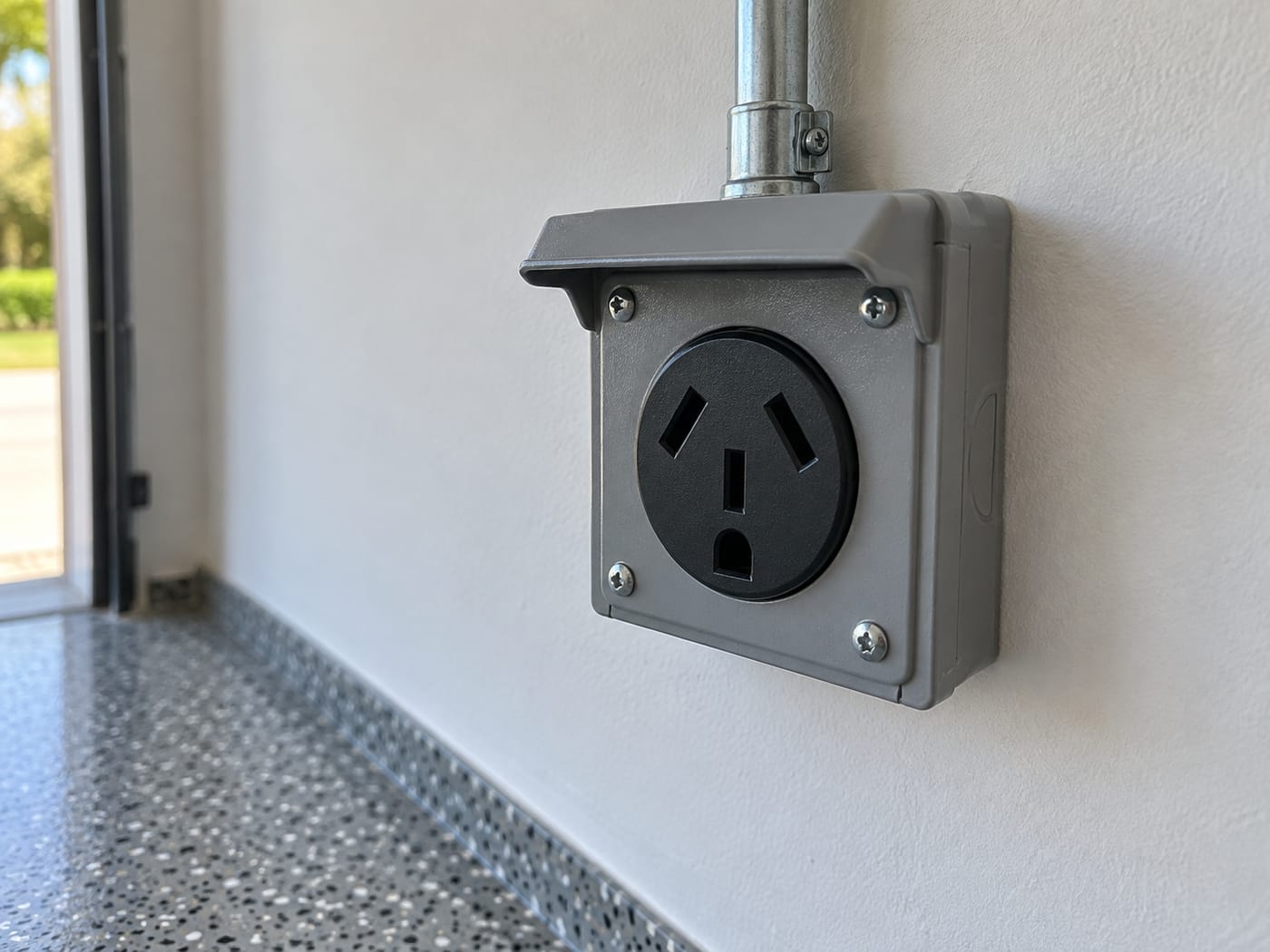
- That means a 240 volt NEMA 14-50 receptacle on a dedicated 50 amp circuit, sized for Level 2 charging.
- It does not require the charger itself. The code covers the wiring, breaker and outlet. The charging unit is a separate purchase whenever the homeowner wants it.
- Doing it during construction costs a fraction of retrofitting. Roughly $280 to $450 at rough-in against $600 to $1,200 after occupancy.
- It changes where things go. That outlet occupies a specific piece of wall, and so do cabinets, a workbench and a slatwall run.
What the code actually requires
The 2026 NEC added Section 210.17, which requires new single-family and two-family dwellings to be built EV-ready. Idaho is among the states that have completed adoption, and the 2026 edition is in effect for new permits.
What that means in practice is a 240 volt NEMA 14-50 receptacle on its own dedicated 50 amp circuit, located in the garage or at a designated parking space, with enough capacity to support Level 2 charging.
One caveat worth stating plainly. Cities and counties can amend, and permit cutover dates vary, so confirm the enforceable edition with your local building department before you plan around it. Twin Falls and Twin Falls County have their own amendment histories and the right answer for your lot is the one your jurisdiction gives you.
What it does not require
This is the part that gets misread.
The code requires the infrastructure, not the equipment. You are getting the wire, the breaker and the outlet. The wall mounted charging unit, the thing people picture when they hear EV ready, is not required and is bought separately whenever the homeowner decides they want one.
That distinction matters because it is what makes the requirement cheap. You are not being made to buy a charger for a car you may not own. You are being given a 240 volt outlet in your garage, which has other uses anyway, including welders, compressors, shop heaters and large tools.
Why doing it now costs so much less
The economics here are unusually clear.
Rough-in during construction runs roughly $280 to $450, covering the 50 amp breaker, six gauge wire, conduit, outlet box and receptacle. The walls are open and the panel is accessible, so it is a short job.
Retrofitting the same thing after the house is occupied runs roughly $600 to $1,200, because now someone is fishing wire through finished walls, working around insulation and drywall, and possibly dealing with a panel that is already at capacity.
That is before you account for the disruption of having it done in a garage that is already full of your belongings.
The Idaho layer nobody mentions
Cold weather is hard on electric vehicle range. Battery chemistry slows in low temperatures, cabin heating draws from the same pack, and a car that comfortably covers a commute in July does noticeably less in January.
Twin Falls sees winter lows around the mid twenties, and unheated garages sit close to outdoor temperature. The practical effect for anyone running an EV here is that winter means charging more often, not less.
Which means the outlet matters more in this climate, not less. A household that charges from a standard 120 volt outlet in summer and gets by will find that same approach frustrating in a Magic Valley February.
It also means the location matters. An outlet on a far wall that requires running a cable across the bay in winter, around a vehicle covered in snowmelt, is a daily annoyance for four months of the year.
Where this collides with the rest of your garage
Here is the part that is actually our business.
That receptacle takes up a specific piece of wall, and it needs clear access to wherever the vehicle parks. So does a cabinet run. So does a workbench. So does a slatwall section. In a two car garage there is not an unlimited amount of usable wall, and these decisions interact.
The sequence that avoids problems is straightforward.
Decide the charger location first, even if you are not buying a charger yet. Which bay, which wall, which side of the vehicle the port is on. That is a five minute conversation that saves a reconfiguration later.
Then plan storage around it. Cabinets and wall systems get laid out knowing where the outlet and the eventual cable run will be, rather than being installed first and worked around.
Floor coating goes down before any of it. Storage is set and levelled on a finished floor, never the other way round. More on sequencing in our renovation timing guide.
Lighting gets planned in the same pass, because you want light where you plug in, not just over the middle of the floor. That is part of what we cover under lighting and audio.
To be clear about scope: the electrical work is a licensed electrician's job, not ours. What we do is make sure the rest of the garage is designed around it rather than fighting it.
If your garage is older
Nothing in this applies retroactively. An existing home does not have to be brought up to the new requirement, and no one is going to make you add an outlet.
But if you are planning a renovation anyway, the walls and the budget are already open. Adding the circuit while a crew is in there is substantially easier than doing it as a standalone job later, and a 240 volt outlet is useful whether or not an EV ever parks there.
Worth checking your panel capacity early in that conversation, because an older service may not have room for a 50 amp circuit without an upgrade, and that is a cost you want to know about at the planning stage rather than halfway through.
Plan the whole room once
A garage renovation touches the floor, the walls, the ceiling and increasingly the electrical. Planning those together costs less and works better than solving them one at a time.
A free in person estimate covers measuring the space, working out how storage and lighting fit around your charging setup, and a flat written price. No pressure, no gimmicks.
Get My Free Quote · (208) 731-1729
Twin Falls, ID. Serving the Magic Valley including Jerome, Kimberly, Burley and Mini-Cassia, Buhl, Filer, Wendell, Gooding and the Wood River Valley.
Frequently asked questions
Does my new home in Idaho have to be EV-ready? If it is a new single or two-family dwelling permitted under the 2026 NEC, it needs an EV-ready outlet in the garage or at a designated parking space. Idaho has adopted the 2026 edition, but confirm the enforceable code with your local building department, since jurisdictions can amend and cutover dates vary.
Do I have to buy an EV charger? No. The code requires the outlet and circuit, not the charging equipment. You can leave it unused indefinitely, and plenty of people will.
What exactly gets installed? A 240 volt NEMA 14-50 receptacle on a dedicated 50 amp circuit, sized to support Level 2 charging.
Is it cheaper to do during construction? Considerably. Rough-in during the build runs roughly $280 to $450. Retrofitting after occupancy typically runs $600 to $1,200 because the walls are closed and the work is harder.
Does this apply to my existing house? No. The requirement applies to new construction. Existing homes are not required to be retrofitted.
Can I use the outlet for something other than charging? Yes. A 240 volt 50 amp receptacle is useful for welders, air compressors, shop heaters and large power tools. For a lot of households that is the more immediate benefit.
Does Garage Pro install EV chargers? No. Electrical work goes to a licensed electrician. What we do is design the floor, storage and lighting around where that equipment lives, so the finished garage works as one room rather than a set of separate decisions.