• Floor Coatings
Epoxy Garage Floor Colors and Finishes in Twin Falls
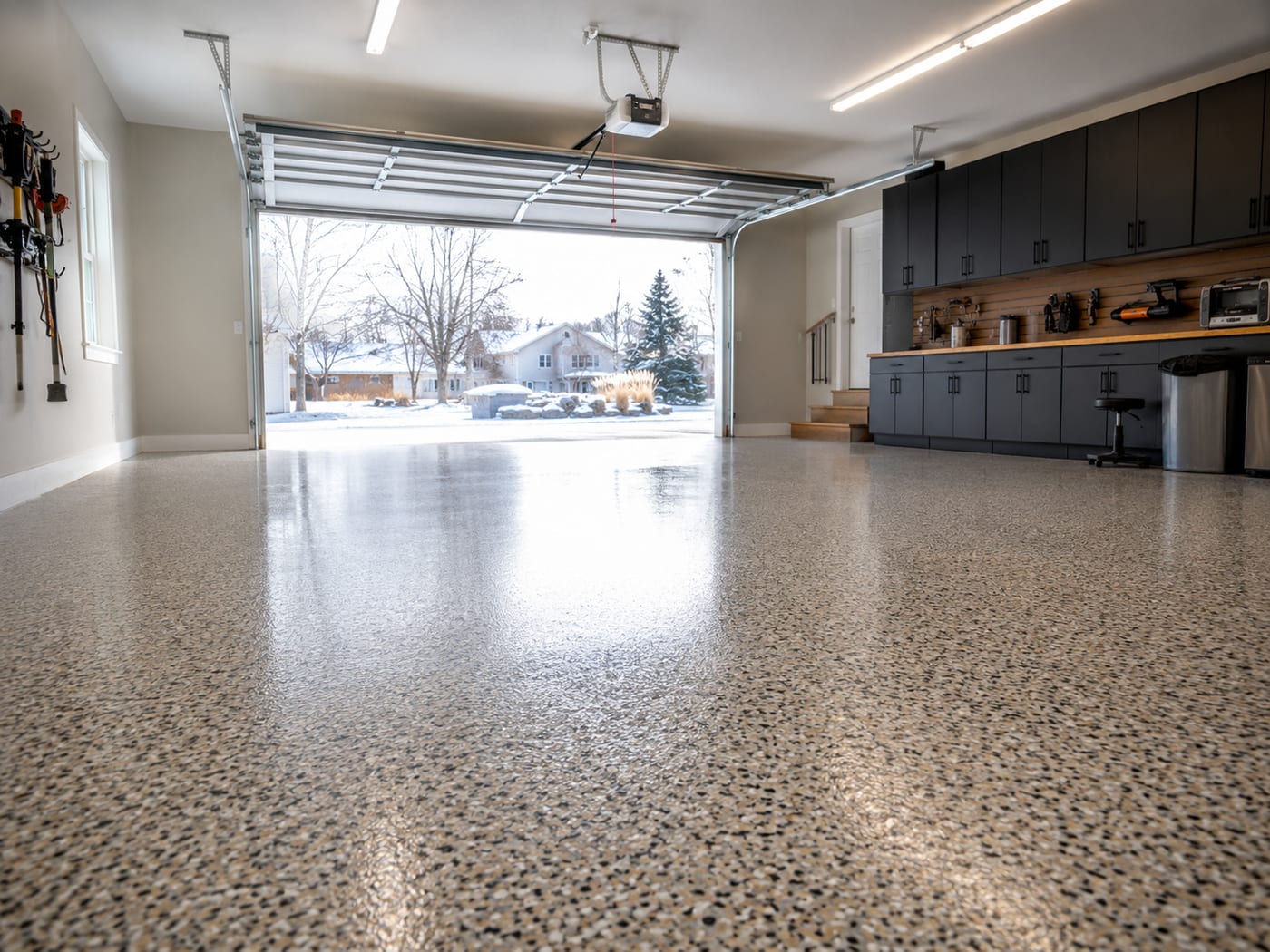
Most Magic Valley garages should get a full flake finish in a mid-tone, multi-color blend. It grips when there is snowmelt on the floor; it hides the pale salt film you track in every winter; it hides the high desert dust that lands the rest of the year, and it costs less than the alternatives.
Metallic is the right call when the garage is a showpiece, and you accept a floor that shows everything. Solid color belongs in shops, farm buildings, and equipment bays where the floor is a work surface rather than a feature.
That is the short version. The longer version matters because finish is the one decision on a coated floor you cannot revisit. Changing it later means grinding the whole thing off and starting over. Here is how to get it right the first time, judged against what Southern Idaho actually puts on your slab.
Start with what your garage is up against
Before you look at a single color chip, be honest about what happens in this room between November and March.
Your tires pick up whatever Idaho Transportation Department crews put on the road. That varies by district and by foreman, but it is generally sodium chloride, magnesium chloride, or calcium chloride brine. You drive it home, it melts off in the garage, the water evaporates, and the chloride dries as a chalky, pale film across the floor.
Meanwhile, the garage itself is unheated for most of us. Twin Falls averages winter highs around 34 degrees and lows around 24, which means the slab crosses the freeze point most days rather than sitting frozen. Snow comes off the vehicle as slush and sits on a cold floor.
Then the other nine months arrive and the problem inverts. What lands on the floor is fine, pale, wind-blown high desert dust, and Twin Falls gets roughly 210 sunny days a year, pushing light straight through an open door onto the surface.
A floor that handles all of that is a narrower target than most color guides admit. Nearly every recommendation below comes back to it.
The three finishes, side by side
Flake | Metallic | Solid color | |
|---|---|---|---|
Look | Speckled, terrazzo like, finished | Marbled, swirled, high drama | Clean, uniform, industrial |
Hides winter salt film | Very well | Poorly | Poorly |
Hides high desert dust | Very well | Poorly | Poorly |
Grip with snowmelt on it | Best | Slick without an additive | Slickest |
Hides slab flaws | Very well | Somewhat | Not at all |
Adds thickness | Yes, significant | Minimal | Minimal |
Cost | Best value | Highest | Lowest |
Best for | Most Magic Valley home garages | Collector bays, finished hangouts | Shops, farm buildings, equipment bays |
Flake: the workhorse, and what we recommend for most Idaho garages
A flake floor is built by broadcasting vinyl chips into the wet epoxy base coat until the surface will not take any more, which the trade calls broadcasting to refusal, then scraping it back flat before the clear coat goes on. The chips end up locked between the base and the top coat rather than sitting on the surface.
People assume flake is decoration. It does three structural jobs that matter more here than the looks do.
It creates grip on a floor that gets wet. The chip edges give the surface texture underfoot and under tire. In a Magic Valley garage, that means traction in February when you step out of the truck onto slush that came off the wheel wells. A slick coating in that moment is worse than bare concrete, and this is the reason we steer working garages toward flake more than any other.
It builds real thickness. A full refusal broadcast adds mil thickness and body that a thin roll-on coating never has. That body is what absorbs the abuse of a garage that sees gravel tracked in off county roads, dropped tools and hot tires in August.
It hides two seasons of mess. The chloride film in winter and the pale dust in summer both disappear into a speckled surface. So does the slab's own history, including minor pitting, patches, and old stains ground down during prep. On a solid color, none of that disappears.
Flake comes in blends rather than single colors, usually three or four chip colors over a base. That is why two floors both described as gray can look nothing alike in person.
We are working on a full blend guide. Until it publishes, we bring blends out to the estimate and look at them in your garage's own light.
Metallic: real drama, and a real trade in this climate
A metallic floor works reflective pigment into the coating and manipulates it while wet, producing a marbled, poured stone effect with depth. No two are alike. If you want the garage to be the thing people remark on when the door goes up, this is how you get there.
Be clear-eyed about what it costs you in a Southern Idaho garage.
Metallic is a labor and material upgrade. It is slower to install; it takes a practiced hand because the installer creates the pattern rather than the product, and it sits at the top of the range on our cost guide for that reason.
More importantly, it shows everything. A metallic surface is smooth and usually high gloss, so the winter chloride haze reads clearly across it, dust reads clearly across it, and so do water spots and fine scratches. It is also the second slickest of the three finishes, and without a slip additive in the top coat that matters on the days you are carrying something in from a truck covered in snow.
Metallic makes real sense in a garage that is not doing hard Idaho garage work. A collector bay. A finished hangout with a TV and cabinets. A third stall that never sees a winter daily driver. Paired with good lighting, it is genuinely beautiful. Paired with a plow truck and a snowblower, it becomes a chore.
Solid color: honest, cheap, and more useful here than most people think
A single color coating with no flake and no pigment effect. It is the least expensive finish, the fastest to install, and in the right setting it looks sharp, with clean lines and an easy surface to mark out zones or stalls on.
In a home garage, it is unforgiving. Every bit of dust, every tire mark, every scratch and every patch in the slab underneath shows on it, and it gives you no texture at all when the floor is wet.
But the Magic Valley is not only home garages. Agriculture drives close to half of this region's economy, and farm shops, dairy utility rooms, equipment bays and commercial buildings have different priorities. In those spaces, the floor is a tool. It needs to seal the slab, resist chemicals, sweep clean and mark out clearly, and a solid color often does that job better and cheaper than anything decorative. We install plenty of it, just usually not in a two-car attached garage.
Choosing a color for a Magic Valley garage
Here is where local specifics beat general advice.
Do not go very dark if you park through the winter
This is the color regret we hear most. The chloride residue that dries on your floor is pale, and on a charcoal or black floor it reads as a permanent white haze from November through March. It mops off with plain water, but you will be looking at it constantly between mops.
On a mid-tone gray or tan blend, the same film is close to invisible.
Do not go very light either
The high desert dust that settles the other nine months is pale, and a very light floor hides it about as poorly as a dark floor hides salt. Oil and tire marks also show hardest on light surfaces.
Both seasons point the same direction. A mid-tone blend carrying gray, tan, and warm neutrals is the most forgiving surface you can put in a Southern Idaho garage. That is a maintenance conclusion, not a style preference.
Lighter floors buy back winter daylight
Idaho winters are short on light, and most garages are working with whatever comes through one door. A light to mid tone floor bounces light back into the room and makes a dim two-car bay feel noticeably more open.
If LED shop lighting is part of the project, these two decisions belong in the same conversation. A bright fixture layout over a dark floor gives you roughly half of what you paid for.
High desert sun is harder on color than you think
With around 210 sunny days a year and a lot of that light landing directly on the slab through an open door, the clear coat is doing more work here than in most markets. A UV-stable polyaspartic clear holds color and clarity. A cheap clear yellows and chalks, and a saturated color has further to fall than a neutral does when that happens.
Elevation changes the calculation
A garage in the Wood River Valley sees a longer, harder winter and more de-icer than one in Filer or Buhl. The higher and colder the site, the more the salt film argument matters and the harder we push toward mid-tone flake. See where we work for the full service area.
Three more rules that hold anywhere
Busy blends fight small rooms. High contrast, large chip blends read as energetic in a big shop and cluttered in a single bay. In a small garage, go quieter.
Decide the floor and the cabinets together. If Signature cabinets are in the plan now or later, choose the floor knowing what is going on the walls. Ten feet of cabinet face is a lot of color, and the two finishes should be picked in one conversation rather than a year apart by two different people.
Gloss shows more than satin. A high-gloss clear looks like a showroom on day one and reveals every fine scratch under low winter light coming in sideways through the door. Satin gives up some of the wet-look shine and stays looking new with less effort. Neither is wrong, but know which one you are choosing.
What does not change, whichever finish you pick
The finish is the part you see. It is not the part that decides whether the floor is still there in ten years.
Underneath all three, the same things have to happen. The slab gets diamond shot blasted so the coating bonds mechanically into the concrete instead of sitting on top of it, and prep is roughly 70 percent of whether a floor lasts. Then a moisture vapor barrier epoxy base seals the moisture rising through the slab, which is what stops a coating from bubbling and lifting from underneath. Then the polyaspartic clear goes on top as armor.
That base coat matters more in Idaho than the finish does. Water wicking up through an unsealed slab, freezing, expanding, and lifting a weak coating is the failure mode this climate specializes in. A beautiful metallic floor over an acid-etched slab with no moisture barrier is a beautiful floor that will peel. A plain gray flake floor built correctly will still be there when you sell the house.
If you are comparing quotes, compare what is under the finish. We have written up how the system is built and what the lifetime wear warranty covers.
What the finish does to your price
Finish is one of four things that move a quote, alongside square footage, slab condition, and how many coats are in the system. Standard full flake is the best value in the category. Multiple blends, custom borders, logos, stall markings and designer metallic all add material and labor and push toward the top of the range.
For real local numbers by garage size, see the Twin Falls garage floor coating cost guide. For your number, we need to look at your concrete.
Common questions
What garage floor color hides dirt best in Idaho? A mid-tone, multi-color flake blend with grays and tans in it. The speckled pattern breaks up tire marks, and the mid tone value hides both the pale chloride film you track in over winter and the light high desert dust the rest of the year. Very dark and very light floors are the two worst performers here.
Is a metallic epoxy garage floor worth it in Twin Falls? It is if the garage is a showpiece and you accept the trade. Metallic gives you a marbled, one-of-a-kind floor that nothing else matches, at a higher price, with the winter salt film and every scratch showing clearly, and less grip unless a slip additive goes in the top coat. For a garage that sees snow, slush, and real tools, flake will make you happier over ten years.
Can I pick my own flake color? Yes. Flake comes in a wide range of blends, from quiet grays and tans to bolder mixes, and we help you match one to your garage, your cabinets and your lighting during the free estimate.
Does the color affect how long the floor lasts? No. Longevity comes from prep and the layers underneath, meaning shot blasting, a moisture vapor barrier, epoxy base, and a UV-stable polyaspartic clear. Color changes how the floor looks as it ages, not how long it survives an Idaho winter.
Is a flake floor slippery when there is snow on my truck? Less so than the alternatives. The broadcast chips create surface texture that gives real traction wet or dry, which is exactly why we recommend it for garages that see snowmelt. Any hard floor can get slick wet, but flake is the most forgiving of the three.
Should the floor match my cabinets? They should be chosen together, which is not quite the same as matching. Coordinating the two is what makes the garage read as one finished room instead of two separate projects, and that is easiest when one company is doing both.
See the blends in your own garage
Color is impossible to judge on a screen. Your lighting, your garage size, and whatever is already on your walls all change how a blend reads, which is why we bring samples and look at the actual space.
Book a free in-person estimate, and we will walk your garage, check the slab, show you the blends in your own light, and give you a flat written price. No pressure, no gimmicks.
Get My Free Quote · (208) 731-1729
Twin Falls, ID. Serving the Magic Valley including Jerome, Kimberly, Burley and Mini-Cassia, Buhl, Filer, Wendell, Gooding and the Wood River Valley. See all service areas →