• Maintenance & Care
How to Care for a Coated Garage Floor in Idaho
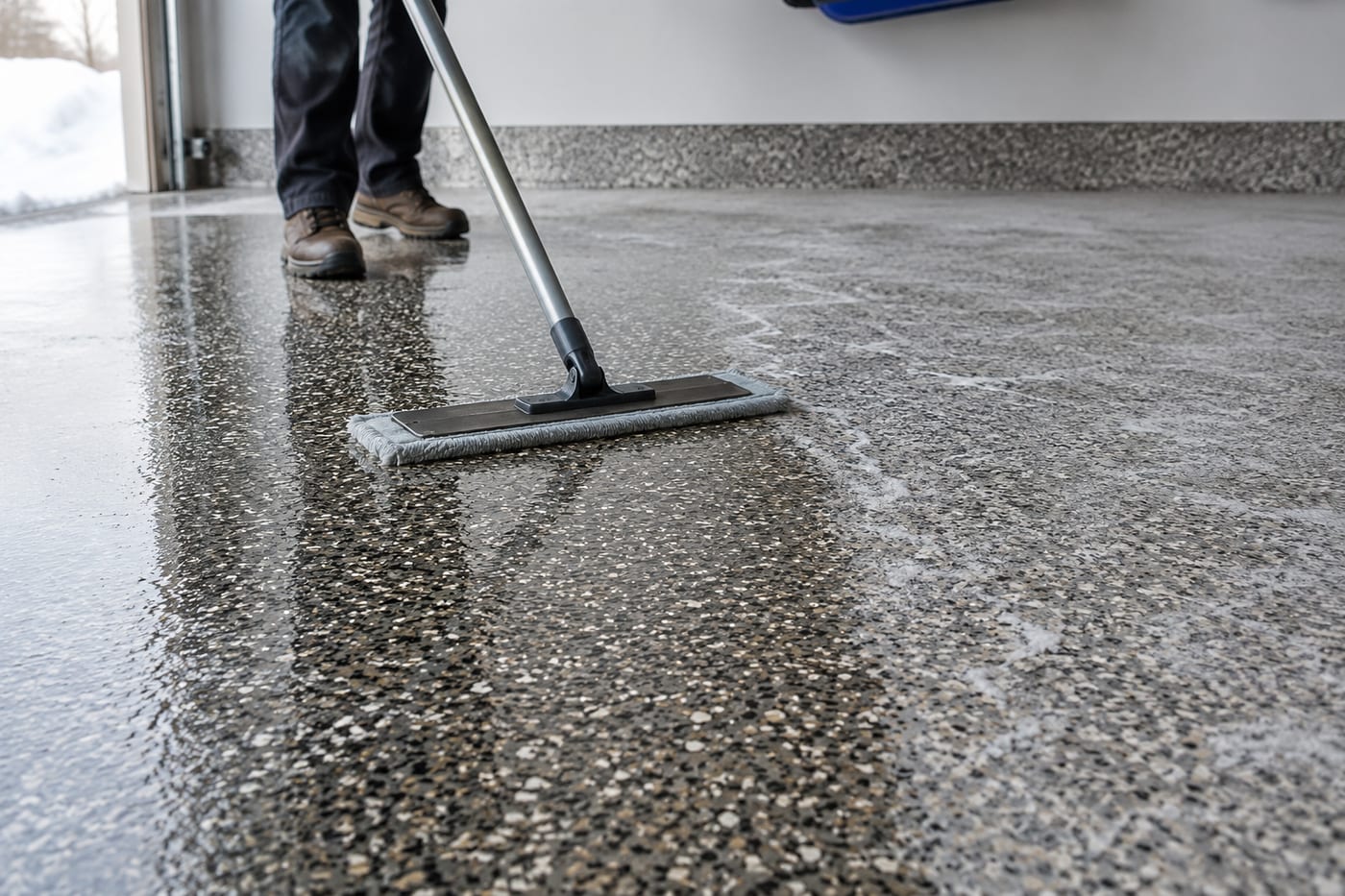
A properly built garage floor coating needs almost nothing from you. Sweep it when it gets dusty, mop it with plain water or a mild cleaner, and rinse the salt off through the winter. That is the whole routine.
What matters more is the short list of things that will damage it. Harsh solvents, aggressive de-icing chemicals, and metal-bladed scrapers can all do real harm to a surface that would otherwise outlast the slab underneath it.
Here is the full picture, including the parts specific to a Southern Idaho garage.
The routine
Sweep or dust mop as needed. High desert dust finds its way into every Magic Valley garage. A soft broom or a dust mop handles it. There is no schedule to keep; just do it when the floor looks dusty.
Mop with plain water, or water with a mild cleaner. That is genuinely enough for a coated floor. The coating is non-porous, so dirt sits on top of it rather than soaking in. You are wiping a surface, not lifting anything out of concrete.
Wipe spills when you notice them. Not because they will stain quickly, but because the longer something sits, the more likely someone tracks it across the rest of the floor.
That is the entire routine for most of the year. If you find yourself scrubbing hard, something is wrong with the method, not the floor.
Winter is the part that actually matters here
Nine months of the year, an Idaho garage floor asks nothing of you. The other three are different, and this is where most avoidable damage happens.
Rinse the salt off. Idaho road crews run sodium chloride, magnesium chloride, and calcium chloride brines through the winter. Your tires pick it up, it melts off in the garage, and the water evaporates, leaving a pale chloride film. On a coated floor, this is a cosmetic problem rather than a structural one, because the coating is doing exactly its job by keeping that chemistry off your concrete. But it builds up, it looks bad, and it is easiest to remove before it dries and hardens. A mop with plain water, or a gentle rinse if your garage drains, takes care of it.
Do not use aggressive de-icer on the floor itself. If you are salting a walkway or a driveway approach, keep it off the coating. The same chemistry that eats bare concrete is hard on a finished surface, and it is the one winter habit most likely to shorten a floor's life.
Deal with pooling. Snow comes off the vehicle as slush and sits. The coating will not be harmed by standing water, but a pool of salty meltwater that dries in place leaves the worst of the film. Squeegee it toward the door or mop it up.
Watch what you scrape with. Ice chippers, metal shovels, and anything with a steel edge will gouge a coating. If something is frozen to the floor, warm water is the answer, not force.
Spills and stains
A coated floor handles the things a garage actually produces. Oil, brake fluid, antifreeze and road grime sit on the surface instead of soaking into porous concrete, which is most of the reason to coat a slab in the first place.
For nearly everything, warm water and a mild cleaner with a soft brush or a microfibre mop is enough. Work from the edge of the spill inward so you are not spreading it.
What to avoid is the instinct to reach for something stronger. Harsh solvents, degreasers with aggressive chemistry, acids and paint strippers can dull, soften or damage the clear coat. That damage is permanent in a way the original spill almost never was.
If something has been sitting for a long time and will not lift with mild cleaning, stop and ask rather than escalating. It is easier to advise on a stain than to fix a floor someone attacked with the wrong product.
What never to use
Avoid | Why |
|---|---|
Harsh solvents, acids, paint strippers | Can dull, soften or damage the clear top coat |
Aggressive de-icing chemicals on the coating | Hard on the finish, and unnecessary on a sealed floor |
Metal-bladed scrapers, ice chippers, steel shovels | Gouge through the coating |
Wire brushes and abrasive scouring pads | Scratch the surface and leave permanent dull patches |
High pressure washing held close to the surface | Can drive water into edges and joints. A gentle rinse is fine |
When in doubt, plain water is never the wrong answer.
The first few days after install
A new coating cures on a schedule. Most garages are a one day install, and you can usually walk on the floor that same evening, but vehicles need longer. Expect to keep the car off it for somewhere between 24 and 72 hours depending on conditions, and go by what the crew tells you at handover rather than by a general rule.
Two things to know for the days immediately before an install, if you have one booked. Do not pressure-wash or hose out the garage in the run-up. A wet slab complicates prep, and the coating needs dry concrete to bond into. And clear the floor completely, since anything left behind has to be moved before work can start.
What the warranty asks of you
Garage Pro's lifetime wear warranty covers wear-through to the concrete and delamination under normal residential use. The homeowner's side of that is straightforward, and it is essentially this article: keep to normal residential use, sweep and mop with plain water or a mild cleaner, and stay away from harsh solvents, aggressive de-icer, and metal-bladed scrapers.
If something does go wrong, the process is to call, have the floor looked at in person, and then repair or recoat the affected area. Full terms are on the warranty page, and Brian confirms them in writing at the estimate.
Common questions
How often should I clean a coated garage floor? There is no fixed schedule. Sweep when it looks dusty and mop when it looks dirty. The exception is winter, when rinsing the chloride film off every few weeks keeps it from building into a haze.
Can I pressure wash my garage floor? A gentle rinse is fine on most coated floors. What to avoid is a high-pressure nozzle held close to the surface, particularly along edges, joints and the door threshold, where water can be driven underneath. For everyday cleaning, a mop does the job with none of the risk.
Will road salt damage my coating? Not the way it damages bare concrete. Sealing the slab against exactly that chemistry is one of the main reasons to coat a garage floor in Idaho. Salt residue is a cosmetic nuisance on a finished floor. Just rinse it off rather than letting it build up, and keep concentrated de-icing product off the coating itself.
What cleaner should I use? Plain water handles most of it. For anything more, a mild general-purpose cleaner is enough. Avoid solvents, acids, degreasers with aggressive chemistry, and anything abrasive.
Do I need to reseal or wax it? No. A polyaspartic top coat is the wear layer, and it is not a surface that needs periodic sealing the way bare or stained concrete does. If a floor eventually shows real wear after many years, that is a conversation about recoating, not a maintenance task.
Can I park a vehicle on it right after install? Not immediately. Foot traffic is usually fine the same evening, but give the floor 24 to 72 hours before parking on it, and follow the specific guidance the crew gives you for your install.
Questions about your floor
If something has ended up on your floor and you are not sure how to get it off, call before you experiment. That is a two-minute conversation, and it has saved plenty of good floors.
And if you are still on bare concrete, an on-site estimate is free. We will walk your garage, look at the slab, and give you a flat written price.
Get My Free Quote · (208) 731-1729
Twin Falls, ID. Serving the Magic Valley including Jerome, Kimberly, Burley and Mini-Cassia, Buhl, Filer, Wendell, Gooding and the Wood River Valley.